PSE VA input testing for power adapters is a mandatory safety evaluation that measures the Volt-Ampere (VA) input of an AC/DC power supply to ensure compliance with Japan’s Electrical Appliance and Material Safety Act. Navigating Japan’s strict DENAN compliance can feel like walking through a complex regulatory minefield. Unexpected lab rejections, skyrocketing compliance costs, and customs delays can easily strand your shipments, draining your B2B launch budget and leaving your customers empty-handed. Our comprehensive guide to safety evaluations breaks down every critical calculation, documentation requirement, and series grouping rule, ensuring your products undergo rigorous PSE testing for power adapters before hitting the Japanese retail market.
What Is PSE Testing for Power Adapters?
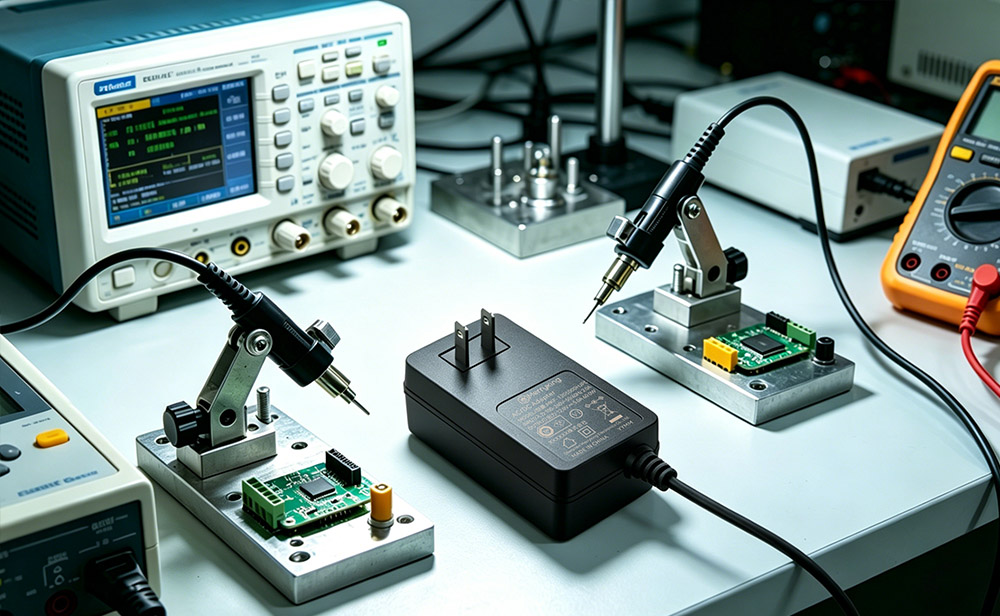
A PSE testing for power adapters process is a mandatory safety and electromagnetic compatibility evaluation required by Japan’s DENAN Law for external power supplies. This regulatory framework, administered by the Ministry of Economy, Trade and Industry (METI), ensures that all imported AC/DC power converters meet stringent build and performance guidelines. By subjecting adapters to rigorous electrical trials, the system actively protects consumers from hazardous shock, fire, and grid instability.
This national certification system bifurcates electrical appliances into two distinct safety tiers based on their inherent risk profiles. AC/DC adapters are designated under Category A, meaning they are considered high-risk items because they interface directly with utility mains voltages. Consequently, manufacturers must obtain third-party certification and satisfy detailed test criteria to legalise their commercial entry into Japan.
The Diamond PSE Mark for Category A Goods
When you are exporting external AC adapters, you must obtain the Diamond PSE mark. This mark proves your product underwent rigorous conformity assessments by an authorized third-party lab.
Here is why: Category A items connect directly to high-voltage mains outlets, posing potential fire and shock hazards.
- Mandatory factory audits to inspect production line quality systems.
- Independent testing by a METI-registered laboratory.
- Five-year certification validity periods for external power supplies.
The Circle PSE Mark for Lower Risk Devices
But that is not all. Lower-risk electronic devices, classified as Category B, only require the self-declared Circle PSE mark.
You must understand that while Category B allows self-declaration, you must still maintain comprehensive technical files to prove conformity with Japanese safety standards if METI requests them.
- Internal testing and self-declaration pathways.
- No mandatory registration with METI-registered third-party labs.
- Unlimited validity, provided design parameters remain unchanged.
Key Takeaway: Identifying whether your product requires the Diamond or Circle PSE mark at the design stage prevents severe regulatory delays and protects your engineering budget.
| Category | Risk Level | Safety Mark | Verification Process | |
|---|---|---|---|---|
| Category A | High Risk (AC adapters) | Diamond PSE | Third-Party Testing + Factory Audit | |
| Category B | Lower Risk (USB devices) | Circle PSE | Self-Declaration + Tech File |
This comparative overview highlights why understanding the precise technical testing metrics, such as Volt-Ampere input, is so critical for compliance.
Why Is VA Input Measured in PSE Testing for Power Adapters?
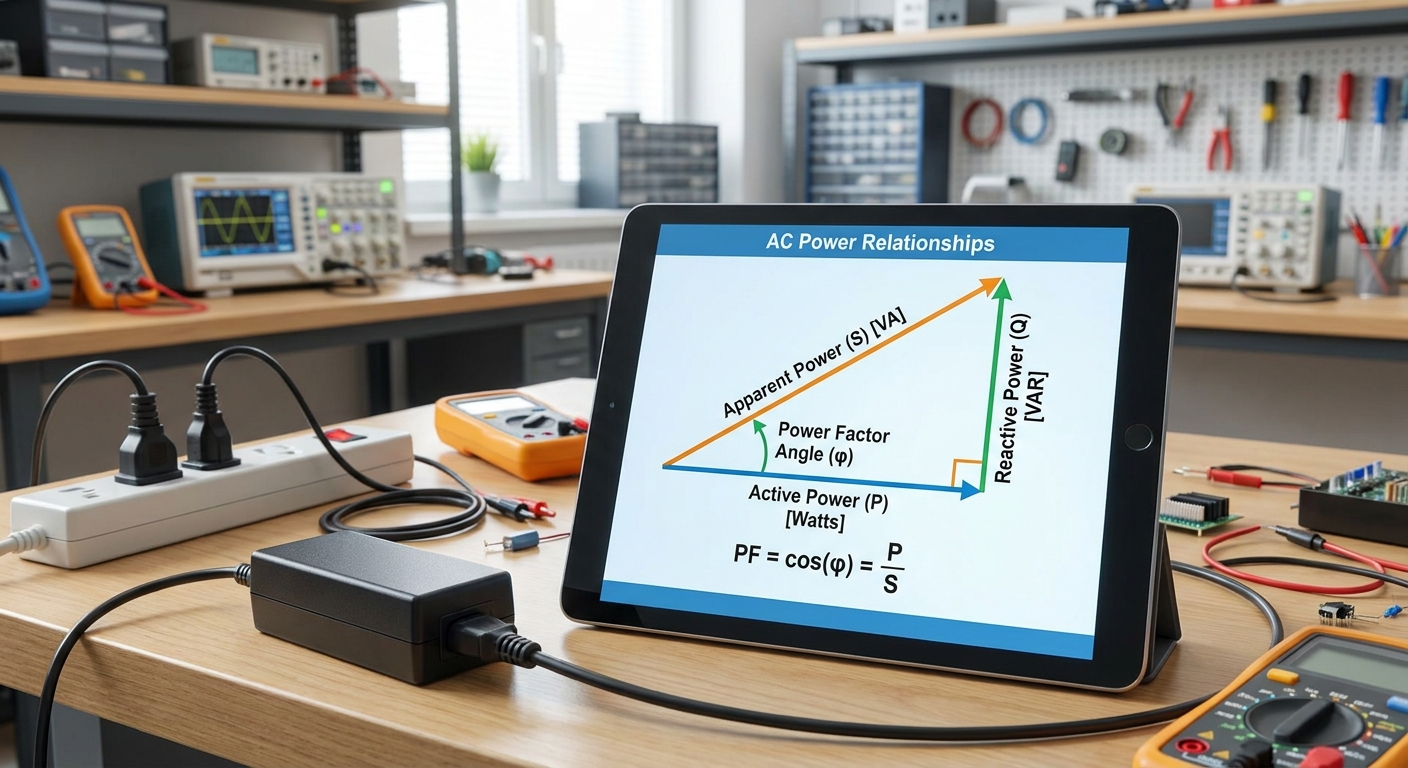
Measuring the Volt-Ampere (VA) input is a critical step in PSE testing for power adapters to evaluate the total apparent power drawn by the device from the AC mains grid, thereby preventing localized infrastructure overloads and electrical fires. This parameter represents the raw vector sum of real and reactive power entering the adapter’s primary circuit. By monitoring this overall draw, testing laboratories can accurately evaluate whether the device places an acceptable current demand on standard building wiring.
Apparent power metrics also help utility administrators predict grid stress during peak operating hours. If an external converter draws excessive VA relative to its actual wattage output, the surrounding electrical infrastructure must handle unnecessary reactive currents. This inefficiency generates excess heat in transmission lines, which is why Japanese inspectors scrutinize input current characteristics so closely.
Preventing Infrastructure Overloads and Fires
Think about it. When you plug in hundreds of low-quality, high-VA adapters simultaneously, the cumulative apparent power can overload building wires and trip breakers.
You must optimize your power factor to keep these currents within safe limits.
- Preventing current leakage and electrical arcing.
- Eliminating unnecessary voltage drops across internal traces.
- Ensuring the adapter shell stays cool to the touch.
Aligning with Japan’s Strict Grid Efficiency Rules
Here is why: Japan’s utility companies enforce tight regulatory parameters on grid noise and efficiency.
Your B2B clients in Japan prioritize highly efficient adapters because they must comply with strict local utility guidelines.
- Preservation of stable municipal power frequencies (50Hz/60Hz).
- Mitigation of harmonic distortions on local distribution transformers.
- Reduction of passive thermal waste across the domestic power grid.
Key Takeaway: Managing your power supply’s VA input prevents severe grid overload risks and guarantees a seamless compliance process under Japan’s energy safety codes.
| Electrical Metric | Safety Risk | Physical Phenomenon | Regulatory Target | |
|---|---|---|---|---|
| Excessive Input VA | Local Overheating | Thermal overload of copper wires | Infrastructure Protection | |
| Unregulated Current | Fire Hazard | High current arcing | Residential Fire Prevention |
Analyzing these physical phenomena shows how raw power impacts safety, leading directly to the formulas used to calculate these metrics in the lab.
How Is Input VA Calculated in PSE Testing for Power Adapters?
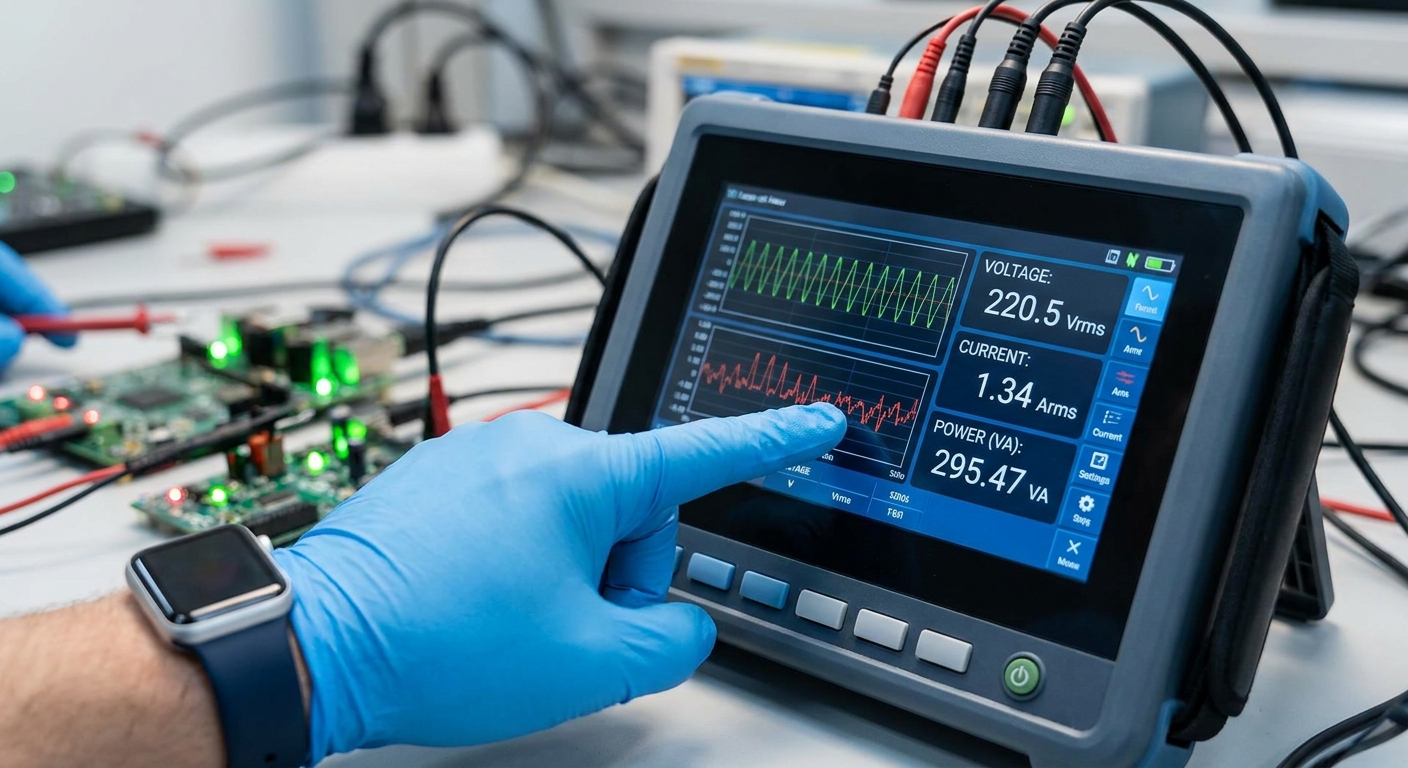
Input VA is calculated during PSE testing for power adapters by multiplying the root-mean-square (RMS) input voltage by the RMS input current under full-rated load conditions. This fundamental formula,
S=VRMS×IRMS
, defines the apparent power drawn by the system. This mathematical approach allows engineers to identify the true electrical load of the device before accounting for power factor losses. Consequently, understanding this calculation is essential for designing highly efficient B2B power systems.
The relationship between real power (measured in Watts) and apparent power (measured in VA) is mathematically defined by the circuit’s power factor (
PF
). In power supplies with poor input filter designs, high harmonic distortion can cause the current waveform to lag behind the voltage waveform, resulting in a low power factor. This phase disparity inflates the required input current, yielding a high input VA that may fail Japanese regulatory limits.
The Mathematical Formula for Apparent Power
But that is not all. You must calculate the apparent power across both nominal Japanese input voltages of 100V and 240V at both 50Hz and 60Hz.
This ensures that your power supply remains stable and safe regardless of where it is deployed on Japan’s split-frequency grid.
- S=VRMS×IRMS for apparent power in Volt-Amperes.
- P=S×PF to determine true active power in Watts.
- PF representing the efficiency ratio of your AC-to-DC conversion.
Advanced Laboratory Testing Equipment Requirements
You cannot simply rely on standard consumer meters to capture these complex AC waveforms.
Certified testing laboratories will use high-precision digital power analyzers to monitor the exact phase angles and harmonics.
- Continuous logging of root-mean-square current fluctuations.
- High-frequency sampling to record current waveform distortion.
- Precise detection of phase angles between AC voltage and current.
Key Takeaway: Utilizing the exact RMS apparent power formula helps your engineering team design input stages that stay well within Japan’s legal current limits.
| Calculation Component | Variable | Measurement Unit | Practical Design Application | |
|---|---|---|---|---|
| Apparent Power | S | Volt-Amperes (VA) | Direct Safety Compliance Metric | |
| Active Power | P | Watts (W) | Device Power Output Capacity | |
| Power Factor | PF | Ratio (0.0 to 1.0) | Input Current Phase Angle Correction |
These calculations demonstrate the rigorous nature of testing, which makes leveraging a single representative model for family certification a highly valuable strategy.
When Can One Representative Model Be Used in PSE Testing for Power Adapters?
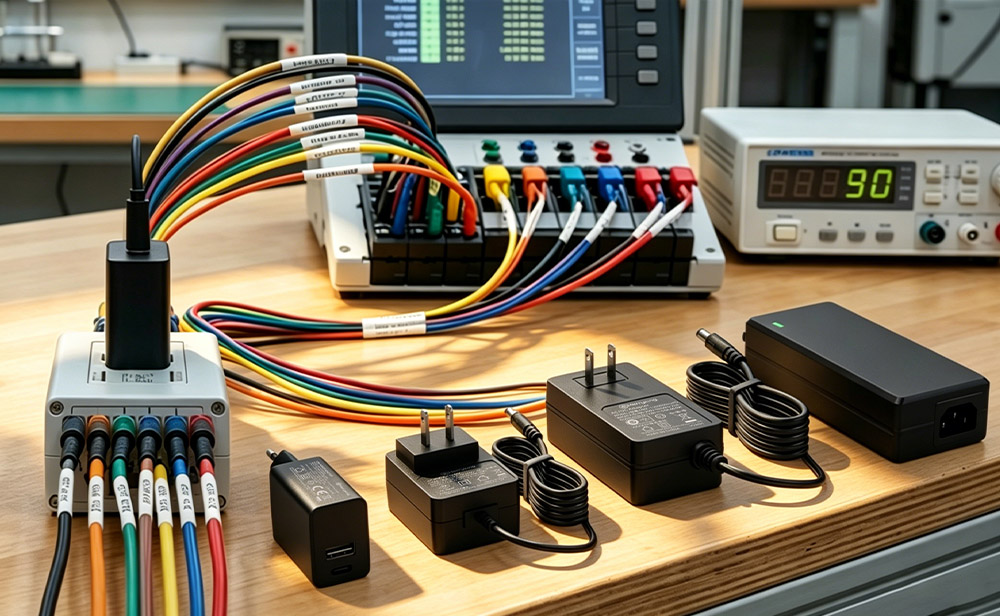
One representative model can be used in PSE testing for power adapters when multiple models share identical circuit schematics, physical structures, safety-critical components, and transformer designs. This regulatory provision allows you to certify an entire family of adapters by testing only the most electrically and thermally demanding model. If this “worst-case” representative model passes the lab’s strict safety and thermal evaluations, METI allows the certification to cover the lower-rated variations. Implementing this strategy saves substantial development costs and accelerates your time-to-market in Japan.
To leverage this cost-saving family approval method, you must conduct a thorough engineering comparison of all models in the series. The selected representative unit must exhibit the highest rated output current or be housed in the smallest physical enclosure within the series. Because small enclosures trap heat and higher currents generate more copper losses, this setup creates the absolute worst-case operating scenario.
Identifying the Worst-Case Thermal and Electrical Model
Here is the secret: the model within your product line that outputs the highest wattage or uses the smallest enclosure will generate the highest temperatures.
You must submit this specific unit for laboratory evaluation to prove that your entire family of adapters meets safe operating standards.
- Highest rated output current causing maximum internal copper losses.
- Smallest physical plastic enclosure restricting passive air cooling.
- Highest nominal input current drawing the maximum input VA.
Streamlining Compliance Costs with Family Approval
Think about it. Certifying a family of ten models using one representative unit reduces your lab fees dramatically.
This smart approach keeps your B2B project agile, preventing budget bloat while maintaining absolute compliance.
- Consolidation of certification documents into a single family report.
- Significant reduction in required physical testing samples and lab hours.
- Shorter time-to-market for auxiliary low-voltage output variants.
Key Takeaway: Selecting your highest-power adapter as the representative model allows you to secure compliance for your entire product line at a fraction of the cost.
| Selection Factor | Ideal Model Choice | Core Scientific Rationale | Compliance Advantage | |
|---|---|---|---|---|
| Output Power | Highest Wattage Model | Generates maximum internal thermal stress | Covers all lower-power variations | |
| Enclosure Size | Smallest Physical Case | Restricts natural passive cooling paths | Proves safety of larger casings |
This selection matrix highlights the importance of understanding the strict architectural rules that define a valid series.
What Makes Power Adapters Part of the Same Series in PSE Testing?
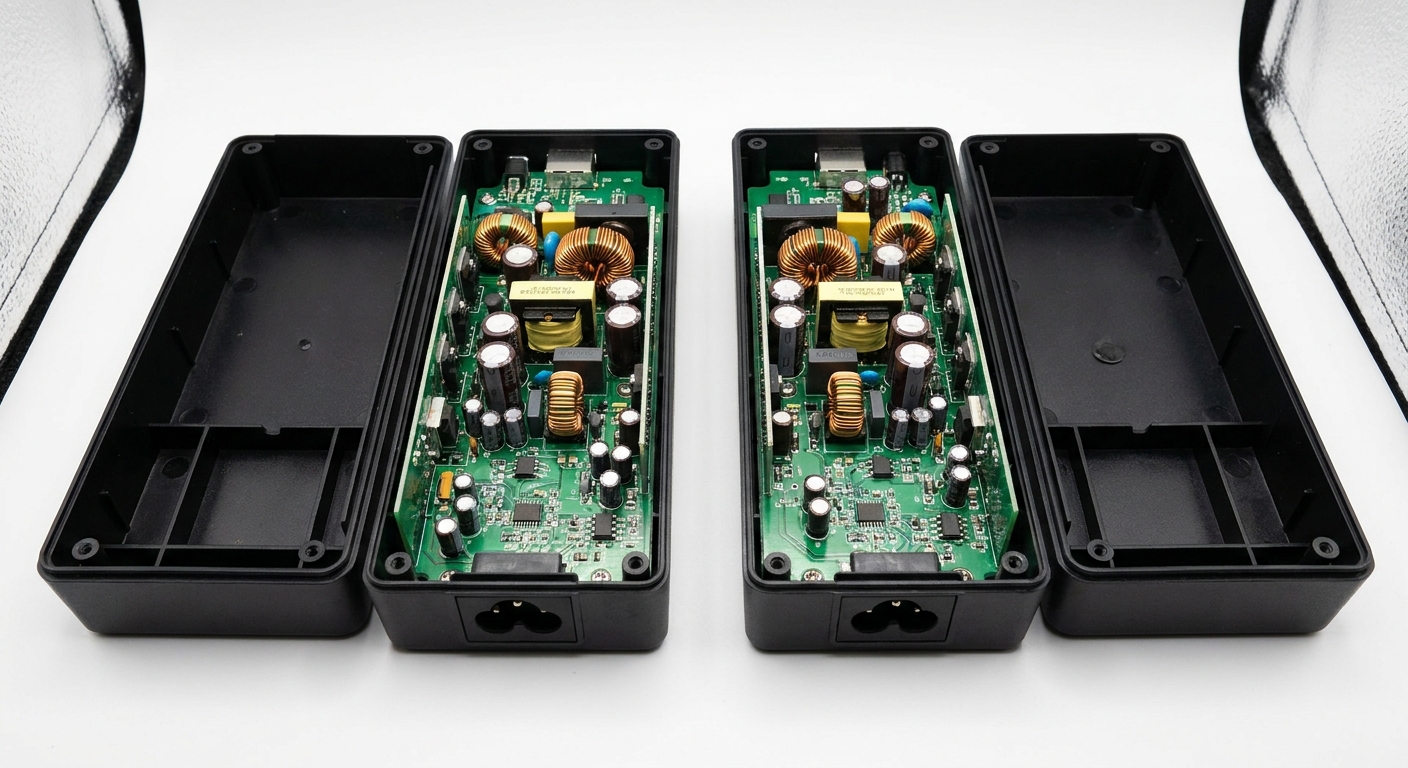
To qualify as part of the same product series in PSE testing for power adapters , multiple models must share the exact same physical PCB layout, primary-side circuitry, and safety-critical component list. Regulators require these identical features because even a minor layout change can alter high-voltage safety margins or electromagnetic interference profiles. Maintaining this architectural consistency across your product line is essential for streamlining global compliance.
Under the rules established by METI-approved laboratories, variations inside a series are only permitted on the secondary (low-voltage) side of the transformer. For example, you can adjust the feedback resistor values or secondary winding turns to output different voltages (such as 12V, 15V, or 24V). However, the primary circuit schematic, the physical distance between high-voltage traces, and the transformer bobbin structure must remain completely untouched.
Strict Uniformity of the Primary Circuitry
But that is not all. You must ensure that the high-voltage primary side of your PCB remains completely identical across all series models.
Any deviation in this layout will immediately invalidate your family testing status and force you to start over.
- Identical primary-side PCB copper trace routing.
- Matching physical clearances between high-voltage paths.
- Consistent mounting locations for key power components.
Harmonized Bill of Materials for Critical Safety Parts
You must specify the same component manufacturers for all critical safety parts inside your adapter series.
If you change your optocoupler or fuse supplier without registering it, you risk losing your compliance status.
- Identical primary fuse ratings and enclosure plastic resins.
- Matching thermal class specifications for winding insulation.
- Unified suppliers for common-mode chokes and filter capacitors.
Key Takeaway: Ensuring absolute uniformity of your primary-side PCB traces and safety components is the only way to successfully qualify for a money-saving series certification.
| Design Parameter | Permitted Series Variations | Prohibited Series Modifications | Certification Action | |
|---|---|---|---|---|
| Primary Circuitry | None | Any trace routing changes | Complete re-testing required | |
| Secondary Circuitry | Output voltage resistor tuning | Transformer core structural edits | File a class modification | |
| Safety Component BOM | Alternative certified fuse brands | Uncertified fuse/capacitor options | Immediate rejection of files |
These structural constraints demonstrate why voltage and current ratings must be carefully engineered within series boundaries.
How Do Voltage and Current Ratings Affect PSE Testing for Power Adapters?
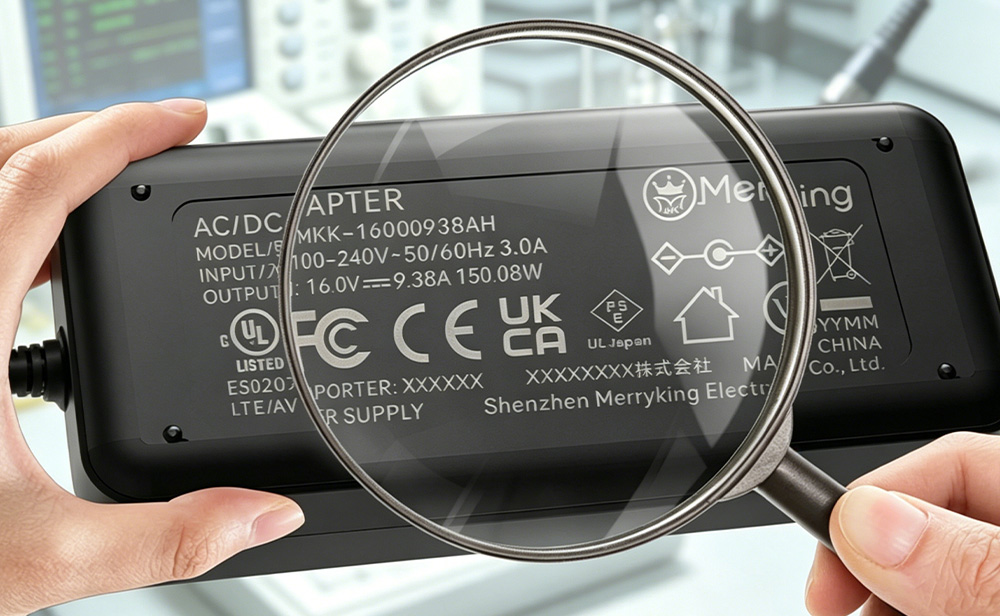
Voltage and current ratings affect PSE testing for power adapters by directly dictating the required physical insulation spacing and maximum thermal limits of internal components. Higher output voltages demand wider physical gaps, known as creepage and clearance, to prevent dangerous electrical arcing across the PCB. Conversely, higher current ratings generate increased thermal energy, requiring thicker PCB traces and larger internal heatsinks to prevent overheating. Managing these dual factors is critical to passing the laboratory’s demanding safety evaluations.
These electrical parameters also define the boundaries of the safety stress tests performed in the lab. For instance, an adapter rated for high input voltages must survive intense dielectric strength tests, where high test voltages are applied across primary and secondary boundaries. If your adapter’s insulation layers are insufficient, current will break through the isolation barrier, leading to immediate failure.
Creepage and Clearance Limits for Higher Voltages
Here is the key: as you design adapters with higher output voltages, your PCB layout must incorporate wider physical gaps to prevent dangerous arcing.
These gaps are strictly measured by test engineers to ensure your device complies with Japanese insulation standards.
- Creepage distance measured across the surface of the PCB.
- Clearance distance representing the shortest path through the air.
- Insulation tape thickness inside the high-frequency transformer.
Thermal Management Under Continuous Max Current Loads
Think about it. Your power adapter’s internal components will heat up exponentially under a continuous maximum current draw.
You must design effective heat-dissipation pathways to protect the external casing from deformation.
- Evaluating temperature rise on critical electrolytic capacitors.
- Measuring heat dissipation across primary switching MOSFETs.
- Testing flame-retardant properties of the plastic enclosure.
Key Takeaway: Balancing your high-voltage insulation clearances with high-current thermal pathways is the key to building an adapter that easily passes Japanese lab tests.
| Electrical Specification | Core Hazard Type | Primary Design Safeguard | Lab Verification Test | |
|---|---|---|---|---|
| High Voltage | Dielectric breakdown / arcing | Wider creepage and clearance distances | 3,000V AC Dielectric Strength | |
| High Current | Thermal runaway / melting | Thicker PCB traces and aluminum heatsinks | Continuous Temperature Rise Test |
Managing these physical ratings successfully relies heavily on compiling the exact technical documentation required for the audit.
What Documents Are Needed for Representative Model PSE Testing?

The documents needed for representative model PSE testing for power adapters include detailed circuit schematics, PCB layout files, a comprehensive Bill of Materials (BOM), and valid safety certificates for all critical components. These technical records are reviewed by the registered conformity assessment body to verify safety margins and track trace routing. Having these files perfectly organized from day one is the best way to avoid costly administrative delays.
In addition to design schematics, Japanese laboratories demand specific transformer construction specification sheets. This documentation must clearly show how the internal windings are wrapped, the number of insulation tape layers used, and the direct thermal rating of the magnet wire. If these files are incomplete, inspectors cannot verify primary-to-secondary isolation compliance.
Essential Engineering Diagrams and Gerber Files
But that is not all. You must provide high-resolution Gerber files and schematics that clearly show the separation between your primary and secondary circuits.
This helps the test lab verify that your layout respects mandatory insulation clearances.
- Multi-layer PCB Gerber files for engineering audits.
- Detailed physical dimensions of the transformer construction.
- Enclosure blueprints highlighting the thickness of the plastic casing.
Component Safety Certificates and Material Datasheets
You must also supply valid safety certificates for every critical component listed in your Bill of Materials.
If your plastic housing lacks a verified flammability rating, your application will face immediate rejection.
- Valid certificates for power inlets and power cord assemblies.
- Material safety data sheets confirming UL94 V-0 flame ratings.
- Verification documents for internal fuses and safety capacitors.
Key Takeaway: Maintaining a perfectly organized compliance dossier of engineering files and component certificates is essential to keep your certification timeline on track.
| File Category | Required Contents | Primary Audit Focus | Submission Status | |
|---|---|---|---|---|
| Gerber / Schematics | Trace layouts & circuit paths | Insulation barrier spacing | Mandatory | |
| Bill of Materials (BOM) | Specific manufacturer part numbers | Component safety certifications | Mandatory | |
| Component Certificates | UL/PSE reports for cords & plugs | Quality and safety compliance | Mandatory |
Preparing this extensive documentation is a critical step to protect your business from the operational and financial risks of compliance failures.
What Risks Occur If Series Models Are Not Properly Covered in PSE Testing?
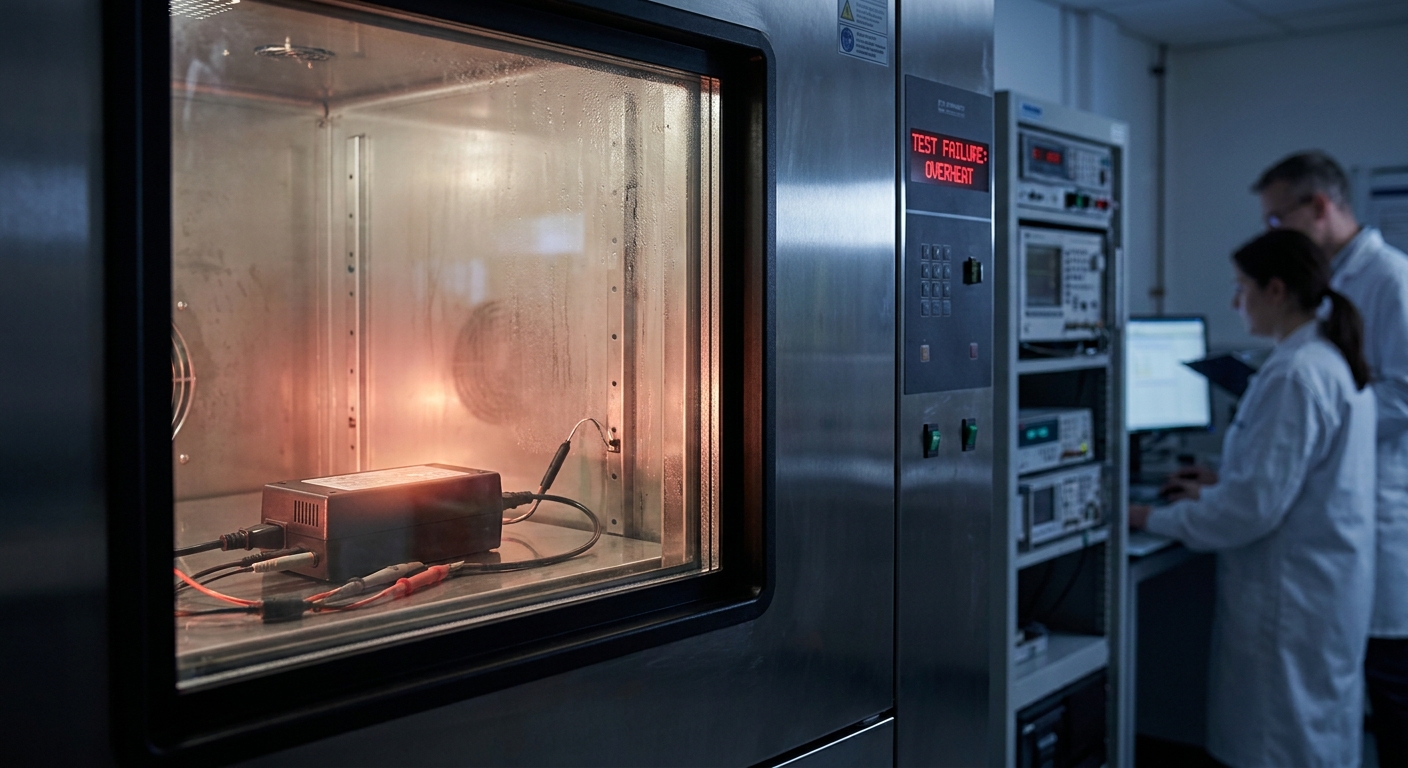
The risks that occur if series models are not properly covered in PSE testing for power adapters include immediate customs confiscation, severe shipping delays, expensive product recalls, and catastrophic brand damage in the Japanese market. If METI or customs officials identify a model in your shipment that does not match a valid conformity certificate, they will halt the entire container. This scenario can leave your business with stranded inventory and massive port storage fees. Furthermore, selling uncertified electrical goods in Japan is a direct violation of federal safety laws.
If an uncertified model is accidentally sold to Japanese consumers, the legal penalties can easily bankrupt a mid-sized B2B enterprise. METI maintains the legal authority to issue public recall orders and levy criminal penalties on the importer of record. This public penalty damages your commercial partnerships beyond repair, as major domestic distributors will permanently blacklist non-compliant brands.
Port Confiscations and Financial Losses
Think about it. Having a major shipment seized at a Japanese port can disrupt your entire supply chain for months.
You will face high demurrage fees while your inventory is held by customs officials.
- Immediate seizure and potential destruction of uncertified models.
- Expensive port storage fees accumulating daily during audits.
- Severe damage to your relationship with Japanese distributors.
Legal Prosecution and Compulsory Product Recalls
Here is the truth: METI has the legal authority to force you to recall every uncertified product from store shelves.
This disastrous scenario ruins your brand’s credibility and exposes your business to massive financial fines.
- Compulsory public recall announcements published on government portals.
- Substantial financial refunds issued directly to wholesale buyers.
- Permanent exclusion from importing future electronic goods into Japan.
Key Takeaway: Verifying that every single model in your shipment is fully covered by your PSE certificate is the only way to avoid catastrophic port holds and brand damage.
| Compliance Failure | Immediate Customs Action | Long-Term Market Impact | Business Solution | |
|---|---|---|---|---|
| Unregistered Series Model | Confiscation at the port | Breach of distributor contracts | Strict series definition audits | |
| Thermal Limit Failure | Mandatory product recall | Public brand damage by METI | Conservative heat margin designs |
These critical risks emphasize why manufacturers must prepare their physical lab samples with extreme care.
How Can Manufacturers Prepare Samples for PSE Testing for Power Adapters?
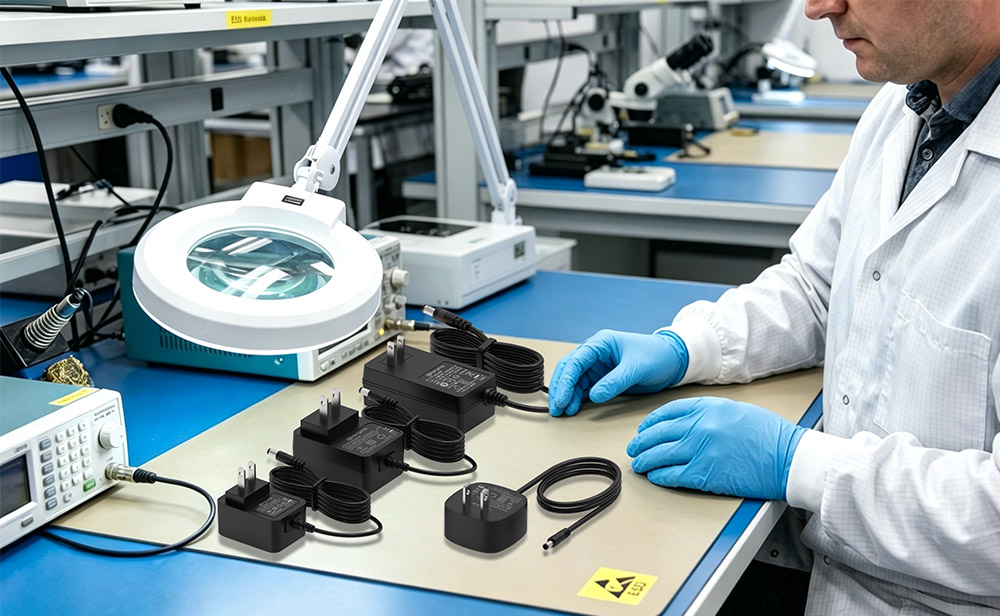
Manufacturers can prepare samples for PSE testing for power adapters by selecting production-grade units that undergo rigorous in-house pre-screening to eliminate any assembly defects or component inconsistencies. Selecting “golden samples” that represent the peak of your manufacturing capability is critical to avoiding minor lab failures. Doing this ensures your samples match the exact design specifications submitted in your engineering files.
You must also prepare specialized sample types to facilitate different laboratory tests. For instance, thermal tests require open-frame samples with pre-soldered thermocouples on high-heat components like the transformer core and switching transistors. Providing these customized sub-assemblies allows technicians to begin physical safety assessments immediately, without needing to dismantle the devices.
Preparing Open-Frame and Unpopulated Samples
You must provide open-frame samples so the laboratory can attach temperature probes directly to internal components during thermal stress tests.
Preparing these specialized units beforehand ensures that testing proceeds smoothly without any physical assembly issues.
- Open-frame units with easily accessible hot spots.
- Blank, unpopulated PCBs to evaluate copper clearances.
- Extra loose transformers for destructive winding testing.
Conducting Thorough In-House Safety Pre-Screening
But that is not all. You should perform rigorous pre-testing inside your own facility to eliminate obvious assembly errors before sending samples to Japan.
This simple step prevents your team from facing disappointing rejections over basic solder issues.
- Preliminary dielectric strength tests at nominal parameters.
- In-house thermal imaging of the adapter under maximum load.
- Visual inspection of plastic seams and alignment of AC pins.
Key Takeaway: Providing a comprehensive set of cleanly populated PCBs and open-frame sub-assemblies allows technicians to complete thermal testing without delays.
| Prepared Sample Type | Quantity Required | Physical Preparation State | Core Testing Objective | |
|---|---|---|---|---|
| Finished Adapter | 5 to 10 units | Production-ready, fully sealed casing | Mechanical drops and EMI sweeps | |
| Open-Frame Unit | 2 units | Accessible PCB with attached leads | Component temperature rise tests | |
| Raw Transformer | 3 units | Standalone winding sub-assembly | Destructive insulation breakdown |
Once these samples are successfully certified, buyers must know exactly how to inspect physical markings to verify legitimacy.
How Can Buyers Verify Valid PSE Testing for Power Adapters?
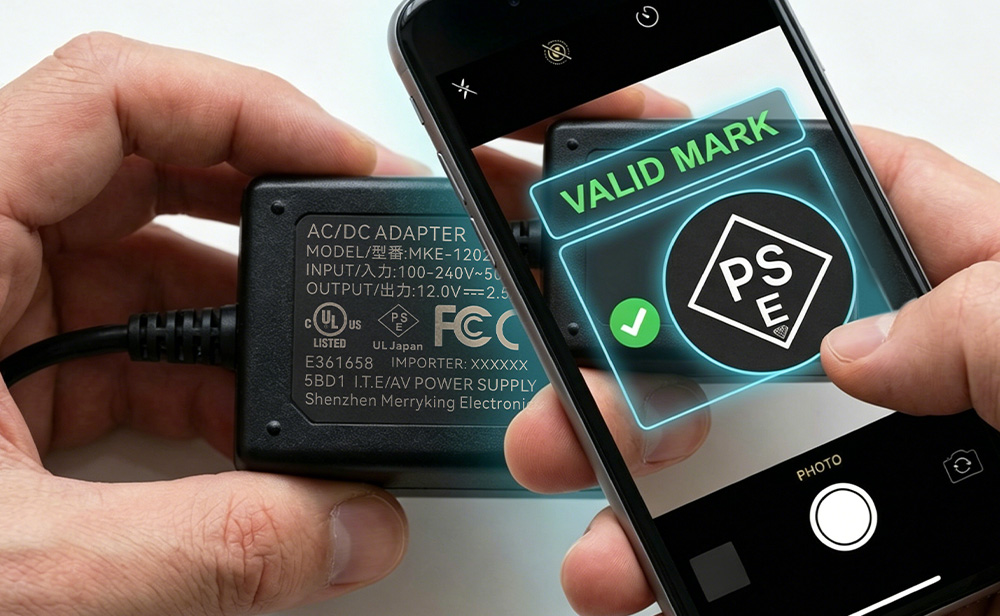
Buyers can verify valid PSE testing for power adapters by cross-referencing the certificate’s registration number with the database of the issuing registered conformity assessment body and inspecting the physical product labels for mandatory markings. This systematic auditing process is essential because fraudulent or altered compliance documents are common in the global electronics trade. By taking these simple verification steps, you protect your supply chain from illegal, non-compliant merchandise. Failing to verify these credentials could expose your company to severe regulatory penalties upon importation.
A valid physical label contains several distinct markers that serve as proof of compliance. It must feature the official Diamond PSE logo, the name of the METI-registered laboratory, and the registered name of the Japanese importer of record. If any of these elements are missing or formatted incorrectly, the adapter is legally ineligible for commercial distribution in Japan.
Auditing the Certificate with Authorized Testing Bodies
Here is the secret: you must always contact the issuing laboratory directly to verify the certificate number in their system.
Dishonest suppliers may copy valid certificate numbers and paste them onto completely different, uncertified adapter designs.
- Confirming that the issuing lab is a METI-registered body.
- Verifying that your factory address matches the certificate exactly.
- Checking the active status and expiration date of the PSE report.
Inspecting Physical Markings on the Adapter Label
Think about it. If the physical adapter does not display the Diamond logo alongside the importer’s name, it is legally unsellable.
You must inspect the laser-etched markings on your production samples to ensure they are clear, permanent, and accurate.
- Confirming the presence of the registration symbol and laboratory mark.
- Verifying the physical durability of the labeling ink or engraving.
- Double-checking that the rated voltage matches Japanese 100V grid specifications.
Key Takeaway: Establishing a routine audit protocol for both paper certificates and physical laser-etched markings protects your business from compliance fraud.
| Verification Step | Target Parameter | Auditing Method | Core Purpose | |
|---|---|---|---|---|
| Database Cross-Reference | Certificate ID | Contact issuing METI-registered lab | Eliminate forged certificates | |
| Physical Label Inspection | Diamond PSE logo & importer name | Magnifying glass macro-check | Verify legal retail eligibility |
This verification protocol guarantees a safe product launch, leading directly into our final strategic recommendations and FAQ.
Frequently Asked Questions (FAQ)
Can I sell my power adapters in Japan with only a Circle PSE mark?
No, you cannot legally import or sell standard external power adapters in Japan using only a Circle PSE mark. Because external power supplies are classified as Category A “Specified Electrical Appliances” under the DENAN Law, they require the more rigorous Diamond PSE mark, which demands third-party testing and factory audits.
What’s the best way to handle multiple output models under one certificate?
The most effective strategy is to group your models into a single product series and test only the worst-case representative model. By choosing the model with the highest wattage or smallest enclosure for testing, you can cover all lower-powered variants under a single, cost-effective family certification.
How do I know if my adapter’s PCB qualifies for a series certification?
Your layout qualifies only if the high-voltage primary-side circuitry, trace spacing, and safety-critical components remain completely identical across all models. If any trace routing or creepage distance is modified on the primary side, the laboratory will classify it as a separate series, requiring independent testing.
Can I use existing UL or CB test reports to bypass physical PSE testing?
No, you cannot use external test reports to bypass the mandatory physical safety testing required by Japanese regulations. While UL or CB reports are highly beneficial for the initial document review, METI-authorized bodies must still physically test your samples against specific J-standards and conduct a factory audit.
How do I know if a supplier’s PSE certificate is completely valid and authentic?
You must verify the certificate’s authenticity by cross-referencing its registration ID directly with the issuing conformity assessment body’s online database. Additionally, verify that the physical adapter permanently displays the Diamond PSE logo along with the registered name of the Japanese importer of record.
Conclusion
Successfully navigating PSE VA input testing is essential for the secure, profitable, and legal distribution of external power supplies in the Japanese market. By optimizing your representative model selection, maintaining strict series uniformity, and carefully managing test samples, you protect your business from costly customs blockages and severe legal penalties.
Are you looking to secure a flawless, compliant supply chain for the Japanese market? Contact us today to work with our engineering experts and source fully certified, high-performance power adapters tailored to your precise industrial and consumer electronic needs.