Switching power adapter drop test standards are specialized regulatory and mechanical protocols designed to evaluate whether an external power supply can survive accidental drops without posing electrical hazards. When importing or sourcing hardware, nothing is more frustrating than receiving a bulk shipment of power supplies only to find they crack or fail during basic warehouse and end-user handling.
Imagine the fallout of delivering fragile power units to your B2B clients: costly product recalls, severe brand damage, and dangerous short circuits that threaten end-user safety. If your manufacturers do not rigorously verify impact resistance, you risk facing massive financial liabilities and failed customs inspections during global transit.
Fortunately, implementing a comprehensive switching power adapter drop test during production guarantees that your power solutions can withstand real-world impacts. In this ultimate guide, you will discover the exact drop test standards, procedures, and engineering strategies necessary to secure high-quality, ultra-reliable power products for your market.
What Is a Switching Power Adapter Drop Test?
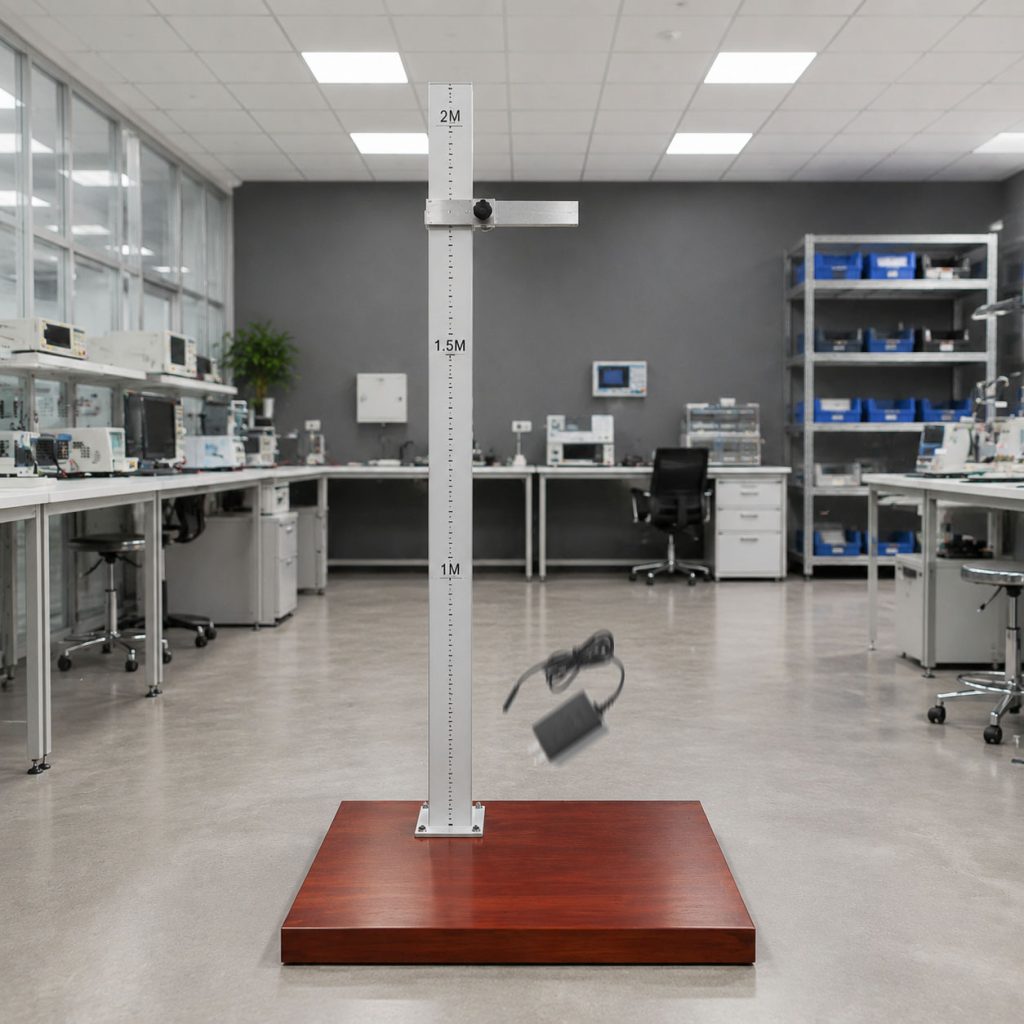
A switching power adapter drop test is a simulated mechanical impact evaluation that tests the physical ruggedness of a power supply housing and its internal circuitry. By dropping the adapter from a pre-calculated height onto a hard surface, engineers can observe how the physical assembly reacts to sudden, severe shocks. This standardized stress test ensures that the external casing does not shatter and expose dangerous high-voltage electrical components.
Manufacturers use specialized automated equipment to control variables like impact angle and surface hardness. This ensures that every evaluation is highly repeatable and scientifically valid. Through this process, you can verify that the adapter remains completely safe for consumer and industrial use.
How Does the Mechanical Shock Occur?
When you drop an adapter, the sudden deceleration converts kinetic energy into a massive mechanical shock wave that travels through the entire structure. Here is why: if your housing materials lack sufficient elasticity, this concentrated energy will rupture the weakest points of your plastic enclosure.
- Housing rupture: Severe stress cracks along sonic welds or seam joints.
- Internal displacement: Heavy components like transformers breaking free.
- PCB fracture: Micro-cracks along copper traces disabling electrical flow.
But wait, there’s more: these structural failures are often invisible to the naked eye. You need a precise drop testing apparatus to capture these microscopic defects before they reach your customers.
What Surface Materials Are Standardized?
To simulate real-world usage, regulatory agencies require dropping the units onto specific, non-resilient surfaces. The best part? These surfaces eliminate variance, so you can easily compare test results across different manufacturing batches.
- Hardwood flooring: Placed over concrete to simulate domestic household drops.
- Steel plates: Used for highly demanding industrial-grade adapter evaluations.
- Smooth concrete: Represents the ultimate harsh test for outdoor or enterprise gear.
By standardizing the landing material, engineers can guarantee that the impact force matches global compliance requirements. This eliminates guesswork and ensures your products meet international commercial benchmarks.
| Surface Material | Standard Thickness | Simulated Environment | Target Application | |
|---|---|---|---|---|
| Hardwood on Concrete | 20mm Hardwood | Domestic & Office | Consumer Electronics | |
| Solid Steel Plate | 10mm Steel | Industrial & Rugged | Factory Automation | |
| Industrial Concrete | Unyielding Concrete | Enterprise & Outdoor | Telecom & Infrastructure |
This clear breakdown underscores how drop test performance impacts global distribution safety.
Key Takeaway: Understanding these surface specifications allows you to specify the exact structural testing criteria required for your market segment, preventing unexpected field failures.
Why Is a Switching Power Adapter Drop Test Critical?
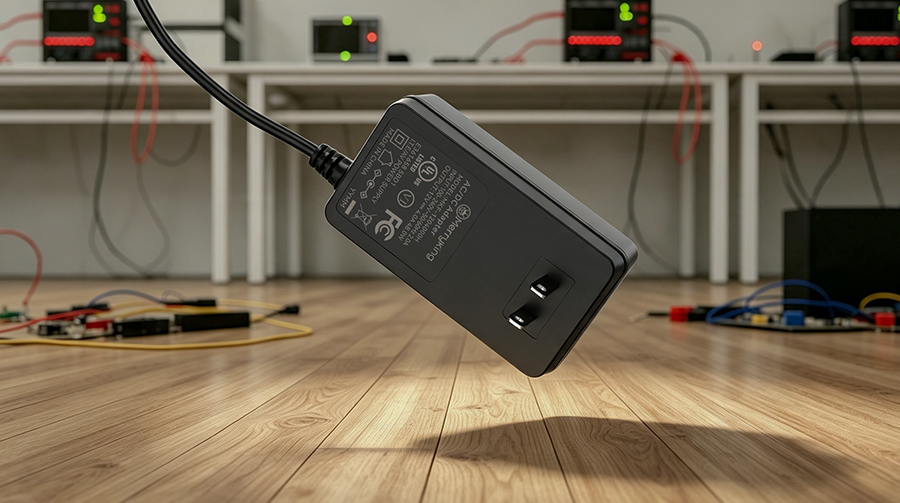
A switching power adapter drop test is critical because it directly prevents life-threatening electrical hazards, high-voltage exposures, and costly product recalls. When an adapter falls from a table, any structural failure can bridge the isolation gap between primary AC and secondary DC circuits. This breach risks exposing the user to lethal high-voltage electrical shocks upon contact.
Furthermore, physical resilience directly protects your brand equity and shields you from expensive liability claims. Ensuring your product survives daily drops guarantees continuous operational uptime for critical connected devices.
How Does This Prevent Shock Hazards?
Inside any modern power supply, a critical physical distance known as creepage and clearance separates dangerous high voltages from safe low voltages. Here is why: if a sudden impact shatters the internal barriers, those high-voltage components can easily touch the low-voltage output lines.
- Creepage breach: PCB fractures allow high-voltage arcs to cross physical gaps.
- Enclosure cracks: Open holes allow fingers to directly touch live AC contacts.
- Lead detachment: Loose wire leads contact the secondary side.
The result? Your consumer ends up holding a live wire, creating an immediate fire and shock emergency. Utilizing drop tests ensures these internal barriers remain completely intact under stress.
Why Is Brand Protection Crucial?
In the B2B landscape, a single batch of defective power units can destroy a decade of built-up trust with your clients. But wait, there’s more: replacing failed adapters under warranty is an administrative and financial nightmare that eats away your profit margins.
- Warranty claims: Escalating costs for replacing hundreds of broken enclosures.
- Contract penalties: Missed deadlines and service level agreement (SLA) fines.
- Brand reputation: Negative reviews that ruin your market standing permanently.
The best part? Investing in verified impact testing from the start completely eliminates these unnecessary financial liabilities, keeping your supply chain stable.
| Risk Category | Untested Adapter Outcome | Drop-Tested Adapter Outcome | Business Impact | |
|---|---|---|---|---|
| Electrical Safety | High risk of user shock | Absolute electrical isolation | Avoids regulatory fines | |
| Mechanical Integrity | Casing shatters easily | High impact absorption | Zero plastic waste | |
| Brand Reputation | Recalls and high returns | Positive feedback and loyalty | Sustained sales growth |
This clear breakdown underscores how drop test performance impacts global distribution safety.
Key Takeaway: Eliminating fragile power components protects both user lives and your B2B contract margins, guaranteeing long-term commercial success.
Which Standards Apply to a Switching Power Adapter Drop Test?

The standards that apply to a switching power adapter drop test primarily include IEC/EN 62368-1 for IT and audio-video equipment, alongside UL 60950 and IEC 60601-1 for medical gear. These international safety frameworks mandate specific mechanical strength evaluations to verify that power supplies remain safe under mechanical abuse. Compliance with these protocols is non-negotiable if you want to legally import and distribute electronics globally.
Each safety regulatory standard has its own set of testing procedures, impact criteria, and post-test inspection protocols. Knowing which standard matches your target market will keep your product development timeline on track.
What Is the IEC 62368-1 Requirement?
The IEC 62368-1 standard replaced older IT and AV standards, introducing a hazard-based safety engineering approach. Here is why: it focuses on classifying energy sources and ensuring your protective barriers can withstand real-world physical abuse.
- Drop test requirement: Dropping the device three times onto a hardwood surface.
- Stress relief test: Baking the plastic casing at high temperatures before dropping.
- Post-drop assessment: Enclosure must not expose any hazardous voltage sources.
But there is a catch. If your plastic enclosure exhibits even a minor hairline crack that allows test probes to touch internal circuits, the adapter fails certification instantly.
How Do Medical Standards Differ?
Medical power adapters governed by IEC 60601-1 face far more stringent drop standards than standard commercial electronics. The best part? These extreme measures protect highly vulnerable patients and hospital personnel from catastrophic electrical shocks.
- Higher drop repetitions: More extensive cycles to guarantee long-term housing strength.
- Extreme isolation testing: Insulating barriers must pass high-voltage dielectric tests after drops.
- Zero leakage allowance: Strict limits on any residual electrical current escaping the housing.
When you source medical-grade switching power supplies, you must verify that your manufacturer holds authentic certifications and maintains a rigorous testing regime.
| Safety Standard | Primary Application | Drop Count | Key Requirement | |
|---|---|---|---|---|
| IEC/EN 62368-1 | Consumer IT & Audio/Video | 3 Drops | Safe-to-touch enclosure integrity | |
| IEC 60601-1 | Medical Equipment | 3+ Drops | Ultra-low leakage current post-test | |
| UL 1310 | Class 2 Power Units | 3 Drops | Strict fire retardant housing specs |
This clear breakdown underscores how drop test performance impacts global distribution safety.
Key Takeaway: Sourcing power adapters certified to IEC 62368-1 ensures your products clear global customs smoothly and satisfy international retailers.
How Is a Switching Power Adapter Drop Test Performed?

To perform a switching power adapter drop test, laboratory technicians secure the unit in a precision mechanical rig that drops it from a set height onto a rigid hardwood or steel plate. The test is carefully calibrated to ensure the adapter hits the surface at precise angles, including its corners, edges, and flat faces. This multi-angle approach ensures that the impact stress is distributed across all potential weak points of the enclosure.
Technicians conduct these trials inside controlled laboratories using standardized drop machines. This professional setup eliminates human error and guarantees highly accurate physical simulation metrics.
What Equipment Is Used in Testing?
A professional laboratory utilizes specialized drop testers that feature magnetic releases and adjustable orientation clamps. Look: this high-tech setup guarantees that the adapter falls in a perfectly controlled physical orientation without any rotational variance during flight.
- Pneumatic clamps: Grips the unit securely and releases it instantly.
- Orientation jig: Holds the adapter at exact angles (e.g., 45 degrees).
- High-speed camera: Records the exact moment of impact to analyze casing flexing.
By capturing these data points, engineers can pinpoint exactly where the plastic case absorbs the most strain. This helps them optimize the physical ribbing and internal support structures.
What Are the Post-Test Inspection Steps?
Once the mechanical drop cycles are complete, the adapter must pass a series of rigorous electrical and physical inspections. Here is why: even if the casing looks perfectly fine, internal components might have shifted dangerously close together.
- Visual inspection: Checking for cracks, loosened pins, or exposed metal.
- Dielectric strength test: Applying high voltage to verify internal insulation.
- Functional check: Plugging the unit in to confirm it still outputs correct voltage.
The best part? If the adapter continues to work flawlessly and maintains full isolation safety, it is officially classified as a certified pass.
| Testing Step | Action Performed | Key Equipment | Success Criteria | |
|---|---|---|---|---|
| Mounting & Alignment | Secure adapter at specific angles | Orientation jig, clamps | Zero pre-drop sway | |
| Free-Fall Release | Gravity drop from set height | Magnetic release mechanism | Clean vertical drop path | |
| Inspection & Verification | Run dielectric and function tests | Multimeter, Hi-pot tester | Safe output & zero damage |
This clear breakdown underscores how drop test performance impacts global distribution safety.
Key Takeaway: Professional drop test execution ensures every power adapter can survive real-world shipping and everyday handling accidents.
What Drop Height Is Required for a Switching Power Adapter Drop Test?
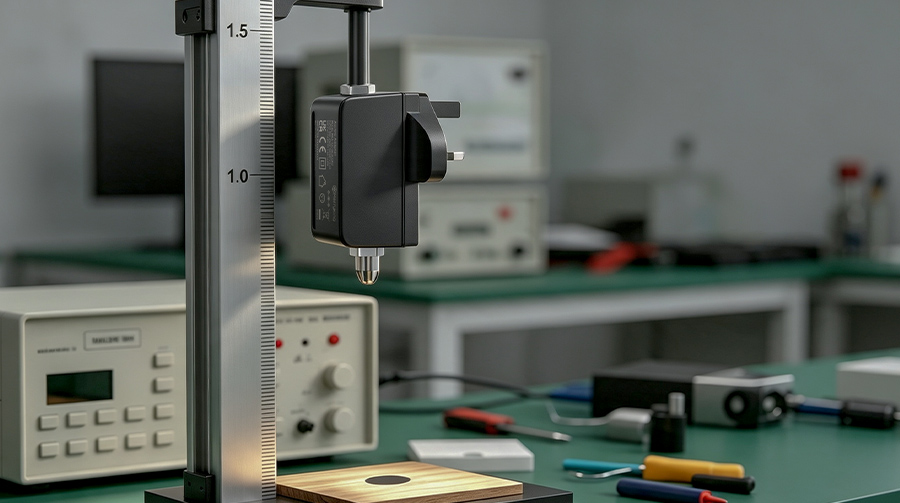
The drop height required for a switching power adapter drop test is typically set at exactly 1.0 meter (approximately 3.3 feet) for standard IT and consumer electronic devices. This specific height is chosen because it represents the average height of household desks, tables, and kitchen countertops where adapters are used daily. If an adapter cannot survive a drop from this standard height, it is considered highly vulnerable to everyday household accidents.
For specialized industrial or military-grade power supplies, this requirement can increase significantly up to 1.5 meters or more. Knowing your application’s required drop height ensures you source power adapters with the correct mechanical build quality.
Why Is 1 Meter the Standard?
Most household surfaces and electrical wall sockets reside between 0.5 to 1.0 meter off the ground. Let me explain: when a user accidentally trips over a charging cable, the power adapter is pulled directly from this average height.
- Wall outlet heights: Standard residential outlets sit 30cm to 40cm high.
- Desk heights: Typical office and home desks range from 70cm to 75cm.
- Countertop heights: Kitchen and workshop benches average 90cm high.
Because 1.0 meter represents the absolute worst-case everyday fall height, passing this test ensures your product survives over 95% of accidental household drops.
When Are Higher Drops Required?
Industrial environments and rugged outdoor field operations require far more robust shock protection than typical domestic settings. Here is why: workers in factories or field sites frequently drop heavy tools and electronics onto solid concrete from heights exceeding a meter.
- Industrial standards: 1.2 to 1.5-meter drops onto unyielding surfaces.
- Military standards (MIL-STD-810H): Multiple drops from 1.22 meters onto concrete.
- Handheld devices: Power bricks packaged with rugged scanners or tools require extra testing.
But wait, there’s more: these ruggedized power supplies utilize thicker plastics and protective rubberized bumpers to withstand these high-impact forces without fracturing.
| Application Class | Drop Height Requirement | Impact Surface | Standard Benchmark | |
|---|---|---|---|---|
| Consumer / Office | 1.0 Meter | Hardwood on Concrete | IEC 62368-1 | |
| Heavy Industrial | 1.2 to 1.5 Meters | Solid Steel or Concrete | Custom Client Specs | |
| Military / Tactical | 1.22 Meters (26 drops) | Plywood on Concrete | MIL-STD-810H |
This clear breakdown underscores how drop test performance impacts global distribution safety.
Key Takeaway: Confirming your target application’s drop height standard prevents you from overpaying for military-grade adapters when commercial-grade units suffice.
How Many Switching Power Adapter Drop Test Rounds?
The required number of switching power adapter drop test rounds depends on the specific safety standard applied, but it generally mandates a minimum of 3 to 6 drops. Each individual drop is executed in a unique physical direction to guarantee that all faces, corners, and joints of the adapter absorb the impact. This comprehensive coverage ensures that there are zero hidden mechanical blind spots in the adapter’s physical enclosure.
Under certain specialized standards, testing can extend up to dozens of repetitions to evaluate long-term wear and fatigue. Knowing these cycle counts helps you assess the physical durability of your power supply inventory.
Why Are Multi-Angle Drops Crucial?
If you only drop an adapter on its flat bottom face, you are ignoring the highly vulnerable corners and plastic weld seams. But there is a catch: when a device falls naturally, it almost always rotates in the air and impacts at an awkward angle.
- Corner drops: Tests the structural integrity of the outer casing corners.
- Edge drops: Evaluates the strength of the ultrasonic welding lines.
- Face drops: Assesses the flexing limits of the largest flat plastic surfaces.
The best part? Testing multiple orientations ensures that no matter how your customer drops the device, the housing absorbs the impact without fracturing.
How Do Repetitive Drops Affect Plastics?
Plastic enclosures experience microscopic stress fractures and fatigue over repeated physical impacts. Here is why: while a single drop might not show visible damage, consecutive drops can rapidly weaken the internal structural ribs.
- Micro-cracking: Tiny, invisible internal cracks that grow larger with each drop.
- Weld fatigue: Gradual separation of the ultrasonic seams under stress.
- Internal loosening: Heavy copper components breaking away from their solder joints.
By requiring multiple drop rounds, compliance testing effectively simulates years of domestic use and physical wear in a single afternoon.
| Safety Standard | Total Drops Required | Impact Orientations | Primary Focus Area | |
|---|---|---|---|---|
| IEC 62368-1 | 3 Drops | Varying faces or edges | Primary casing joints | |
| UL 1310 | 3 Drops | 3 different surfaces | Direct wall-plug prongs | |
| Custom Rugged Specs | 10 to 26 Drops | All 6 faces, 8 corners, 12 edges | Complete mechanical durability |
This clear breakdown underscores how drop test performance impacts global distribution safety.
Key Takeaway: Specifying at least 3 to 6 multi-angle drop cycles in your supplier agreement ensures your adapters survive heavy, daily use in busy environments.
What Failures Can a Switching Power Adapter Drop Test Identify?
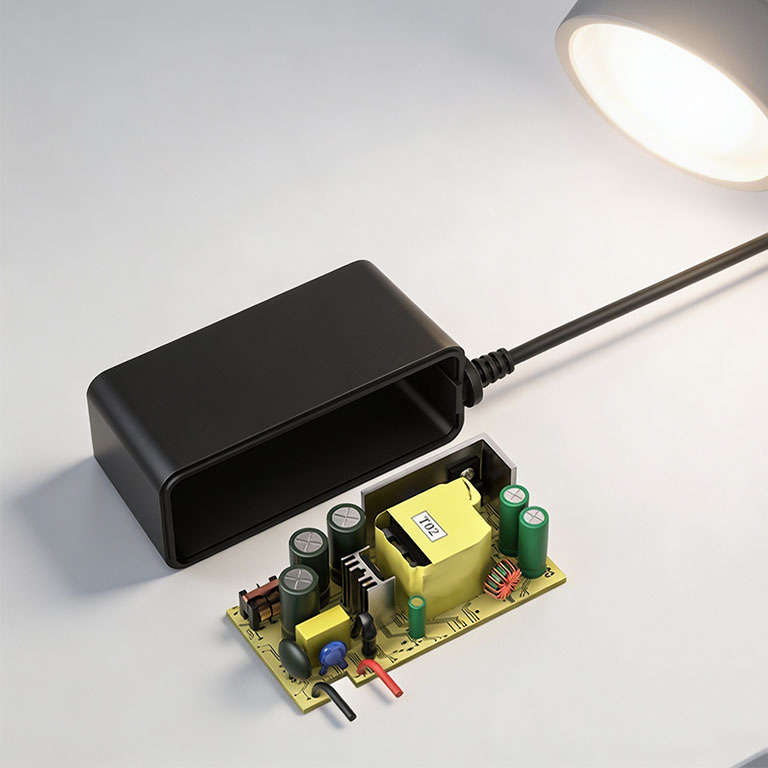
A switching power adapter drop test is engineered to identify critical failures such as fractured plastic seams, loosened electrical solder joints, and detached internal components. These defects are often difficult to detect through visual inspection alone, but physical shock exposes them instantly. Identifying these manufacturing flaws early protects your product line from severe quality issues.
When a power adapter drops, the violent shock wave will split weak ultrasonic welds or snap fragile PCB traces. Investigating these mechanical failures helps engineers optimize the internal layout for maximum durability.
What Are Common Enclosure Failures?
The outer plastic shell is your adapter’s primary safety shield against high-voltage hazards. But wait, there’s more: if the manufacturer uses low-grade recycled plastics or cheap ABS blends, the entire housing can easily shatter upon impact.
- Seam separation: Complete splitting of the ultrasonic welds along the casing seam.
- Prong loosening: AC wall prongs breaking away or pulling loose from their mounts.
- Stress crazing: Small white cracks appearing on high-stress plastic areas.
These physical defects instantly expose live electrical wiring to the user’s touch. Utilizing premium polycarbonate (PC) and optimizing weld parameters completely eliminates this critical safety risk.
What Are Common Internal Failures?
Even if the outer casing survives the impact without a scratch, the internal electronics can suffer severe mechanical damage. Here is why: heavy magnetic components like transformers and inductors act as heavy pendulums that pull against the PCB during a fall.
- Solder joint cracks: Heavy transformers ripping off the circuit board.
- PCB trace cracking: Fractured copper lines breaking the electrical loop.
- Capacitor lead breakage: Solder pins breaking due to intense vibration.
The best part? Adding supportive silicone glue and internal mounting pillars secures these heavy elements, preventing them from shifting or snapping during impact.
| Failure Category | Specific Defect Identified | Root Cause | Preventive Solution | |
|---|---|---|---|---|
| Enclosure | Broken ultrasonic seam | Poor welding energy or cheap ABS plastic | Upgrade to PC material and tune welds | |
| Connection | Detached AC wall prongs | Weak internal brass rivets or thin plastic | Redesign prong anchoring system | |
| Circuitry | Cracked transformer solder | Excessive component weight with no physical glue | Apply structural epoxy or silicone adhesive |
This clear breakdown underscores how drop test performance impacts global distribution safety.
Key Takeaway: Sourcing power adapters that incorporate internal structural gluing and premium polycarbonate housing prevents dangerous internal short circuits.
How Does a Switching Power Adapter Drop Test Aid Reliability?

A switching power adapter drop test aids reliability by serving as a real-world stress simulation that verifies long-term product durability before mass distribution. By intentionally exposing power supplies to mechanical shocks, engineers can discover hidden design flaws and optimize structural geometry. This proactive quality control prevents premature product failures and guarantees continuous power delivery to connected equipment.
Reliable power adapters reduce customer return rates, minimize product liability claims, and protect your brand reputation in highly competitive markets. Integrating drop tests into your quality control workflow ensures that every shipped unit meets top-tier commercial standards.
How Does This Improve Product Lifespans?
Products that undergo mechanical shock testing during development are systematically optimized for ruggedness. Look: when engineers find a weak point, they reinforce the physical casing and internal components to prevent future failures.
- Reinforced enclosures: Thicker plastic walls and protective internal support ribs.
- Resilient materials: Polycarbonate blends that absorb and flex under heavy shock.
- Optimized solder alloys: Solder formulations that resist micro-cracking and physical stress.
As a result, your power adapter can survive years of typical physical abuse in busy offices and homes. This exceptional durability significantly extends the overall service life of your electronics.
Why Does This Lower Return Rates?
Shipping untested electronic products often leads to high return rates and expensive warranty claims. But wait, there’s more: a high volume of defective returns can quickly drain your engineering team’s resources and ruin retailer relationships.
- Fewer DOA units: Less risk of products arriving Dead-On-Arrival (DOA) due to shipping shocks.
- Lower warranty costs: Reduced demand for replacements and logistics processing.
- Stronger retail ties: Retailers trust your brand because of your consistently low return rates.
The best part? Implementing drop test standards during manufacturing guarantees that your products arrive in pristine working condition, ensuring maximum customer satisfaction.
| Quality Metric | Untested Production | Tested & Optimized Production | Long-Term Business Value | |
|---|---|---|---|---|
| Out-of-Box Failure | High risk of transit damage | Near-zero shipping failures | Decreased replacement shipping costs | |
| Lifespan Expectancy | 6 to 12 months (due to drops) | 3 to 5+ years of daily use | Maximized product ROI | |
| Customer Satisfaction | Frequent complaints and returns | Highly positive reviews | Elevated brand equity |
This clear breakdown underscores how drop test performance impacts global distribution safety.
Key Takeaway: Investing in drop-tested switching power adapters dramatically lowers your overall warranty and return expenses, protecting your bottom line.
What’s Vital in a Switching Power Adapter Drop Test Report?
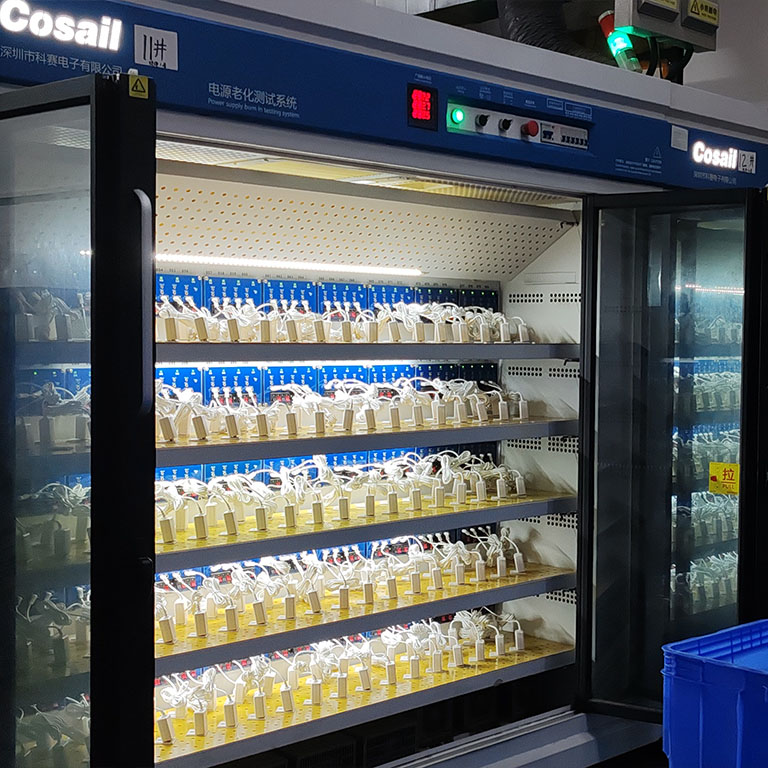
A switching power adapter drop test report must include vital information such as test parameters, height measurements, impact angles, surface materials, and detailed photographic evidence of the results. This comprehensive documentation acts as official proof of compliance, verifying that the product satisfies international safety regulations. For B2B importers, receiving an authentic test report from your supplier is critical before authorizing mass production.
A detailed compliance report protects your business during customs audits and demonstrates product safety to retail buyers. Ensure your manufacturer provides transparent, third-party laboratory test records to guarantee full traceability.
What Parameters Must Be Documented?
A complete engineering report must clearly list the exact setup variables used during testing. Here is why: without these recorded details, it is impossible to verify if the test was conducted correctly under regulatory guidelines.
- Drop height: Documenting the exact distance (e.g., 1.0 meter) to the surface.
- Impact surface: Specifying the landing material (e.g., hardwood over concrete).
- Unit orientation: Detailing the exact angles and faces tested during the drops.
But wait, there’s more: the report should also list the exact model number and production batch of the tested units. This ensures full quality tracking throughout your product lifecycle.
How Are Results Verified and Certified?
To ensure credibility, the drop test report must include formal verification signatures and test stamps from certified laboratory technicians. The best part? Third-party certified reports from laboratories like TÜV, SGS, or UL carry global regulatory recognition.
- Hi-Pot test results: Certified electrical isolation measurements taken post-drop.
- Functional check status: Direct verification that the unit still functions within specifications.
- Visual inspector notes: Written confirmation that no hazardous internal parts are exposed.
Always request these official documents from your power adapter manufacturer prior to shipping. This verification shields your business from importing non-compliant, unsafe hardware.
| Report Section | Critical Data Included | Business Purpose | Compliance Value | |
|---|---|---|---|---|
| Test Setup | Drop height, surface material, angles | Replicates exact regulatory environment | High | |
| Electrical Safety | Hi-Pot isolation data, output voltage | Proves no shock hazard exists post-drop | Critical | |
| Lab Accreditation | ISO/IEC 17025 certification stamp | Validates report authenticity for customs | Essential |
This clear breakdown underscores how drop test performance impacts global distribution safety.
Key Takeaway: Reviewing the drop test report’s Hi-Pot test data ensures that your power adapters are certified safe and ready for commercial sales.
How to Improve Switching Power Adapter Drop Test Results?

To improve switching power adapter drop test results, you must address enclosure wall thickness, plastic material selection, internal ribbing design, and the anchoring of heavy components on the PCB. By reinforcing weak points during the initial CAD design phase, you can prevent structural failures before manufacturing begins. Collaborating with an experienced manufacturing partner ensures that these design optimizations are implemented correctly.
Using advanced shock-absorbing plastics and strategic internal layouts will significantly boost your power supply’s physical resilience. Let’s explore the key engineering techniques that guarantee a passing grade on your next compliance test.
What Enclosure Design Tweaks Help?
Improving the outer housing involves optimizing both plastic material chemistry and structural wall thickness. Here is why: thin, brittle plastics will easily crack under the extreme deceleration forces of a fall.
- Upgrade to polycarbonate: Using pure PC or PC/ABS blends for high impact flexibility.
- Increase wall thickness: Maintaining a minimum thickness of 2.0mm to 2.5mm for housing.
- Add internal ribbing: Designing structural ribs near corners to distribute impact energy.
By rounding sharp corners and strengthening the ultrasonic welding parameters, you can ensure that the outer shell remains completely sealed after multiple drops.
Conclusion: How to Secure Rugged Power Adapters?
Securing rugged power supplies requires partnering with a manufacturer that prioritizes strict mechanical testing and advanced quality control. If you have been struggling with fragile, non-compliant power supplies that fail in the field and ruin your customer relationships, we have the ultimate solution.
- Rugged engineering: Our adapters are built with premium materials and reinforced enclosures.
- Certified testing: Every production run undergoes verified multi-angle drop tests.
- Global compliance: We provide complete, transparent test reports for seamless customs clearance.
Let us help you eliminate the headaches of product recalls and fragile hardware. The best part? Sourcing robust adapters has never been easier. To secure a reliable, certified, and drop-tested supply of premium switching power supplies for your next B2B project, contact us today and speak with our expert engineering team.
| Optimization Area | Design Action | Material / Spec | Impact Resistance Boost | |
|---|---|---|---|---|
| Enclosure Shell | Upgrade outer housing plastic | Polycarbonate (PC) | Outstanding shock absorption | |
| Weld Seams | Optimize ultrasonic welding | Increased melt depth & ribbing | Prevents seam separation | |
| Internal Parts | Secure heavy transformers | Silicone adhesive / epoxy | Eliminates board fractures |
This clear breakdown underscores how drop test performance impacts global distribution safety.
Key Takeaway: Partnering with a dedicated manufacturer like MK Power Adapter guarantees access to certified, highly rugged power supplies designed to thrive in any commercial environment.
Frequently Asked Questions
Can I request customized drop testing heights for my unique industrial B2B project?
Yes, you can absolutely request custom drop heights to match your specific field requirements. Many industrial and military clients require testing at heights of 1.5 meters or more onto concrete. Our engineering lab can program automated drop machinery to execute these specialized parameters and provide certified test reports.
What’s the best plastic material to prevent power adapter casing cracks during a fall?
Polycarbonate (PC) is the best plastic material for high impact resistance and flame retardancy. While standard ABS is cheaper, it is brittle and prone to shattering under shock. Choosing a high-grade PC or a premium PC/ABS blend ensures the housing absorbs and distributes impact forces safely.
How do I know if my supplier’s drop test report is authentic and compliant?
You can verify authenticity by checking for accredited ISO/IEC 17025 laboratory stamps and cross-referencing the report’s certificate number on the testing agency’s database. Authentic reports will always feature high-resolution photos of the setup, detailed post-test Hi-Pot measurements, and the signature of a certified QA engineer.
Can a power adapter still be certified if it has small cosmetic scratches after a drop?
Yes, minor cosmetic scratches or scuffs are completely acceptable under global safety standards. The primary success criterion is that the enclosure remains intact without any cracks that expose high-voltage components or allow access to live internal parts. The device must also pass post-drop electrical isolation and functional tests.
How do heavy internal components like transformers affect drop test performance?
Heavy components significantly increase the risk of internal physical damage due to kinetic momentum during a fall. If these elements are not securely anchored, they will rip off the PCB and tear solder joints. Applying strong structural silicone glue or mechanical anchors is essential to stabilize them.