The core difference between a power adapter and a battery charger is that a power adapter provides a constant voltage to run a device directly, whereas a battery charger delivers dynamically managed voltage and current to safely replenish chemical storage cells. Imagine you are finalizing a new hardware product design, only to face a critical choice regarding how it receives power. Choosing the wrong external power setup can degrade cell life, cause safety failures, or delay your regulatory approvals for global distribution. By understanding the electrical distinction between these two components, you can ensure system reliability, protect your design budget, and optimize development speed when choosing a power adapter vs battery charger for your next project.
① What Is the Difference Between a Power Adapter vs Battery Charger?
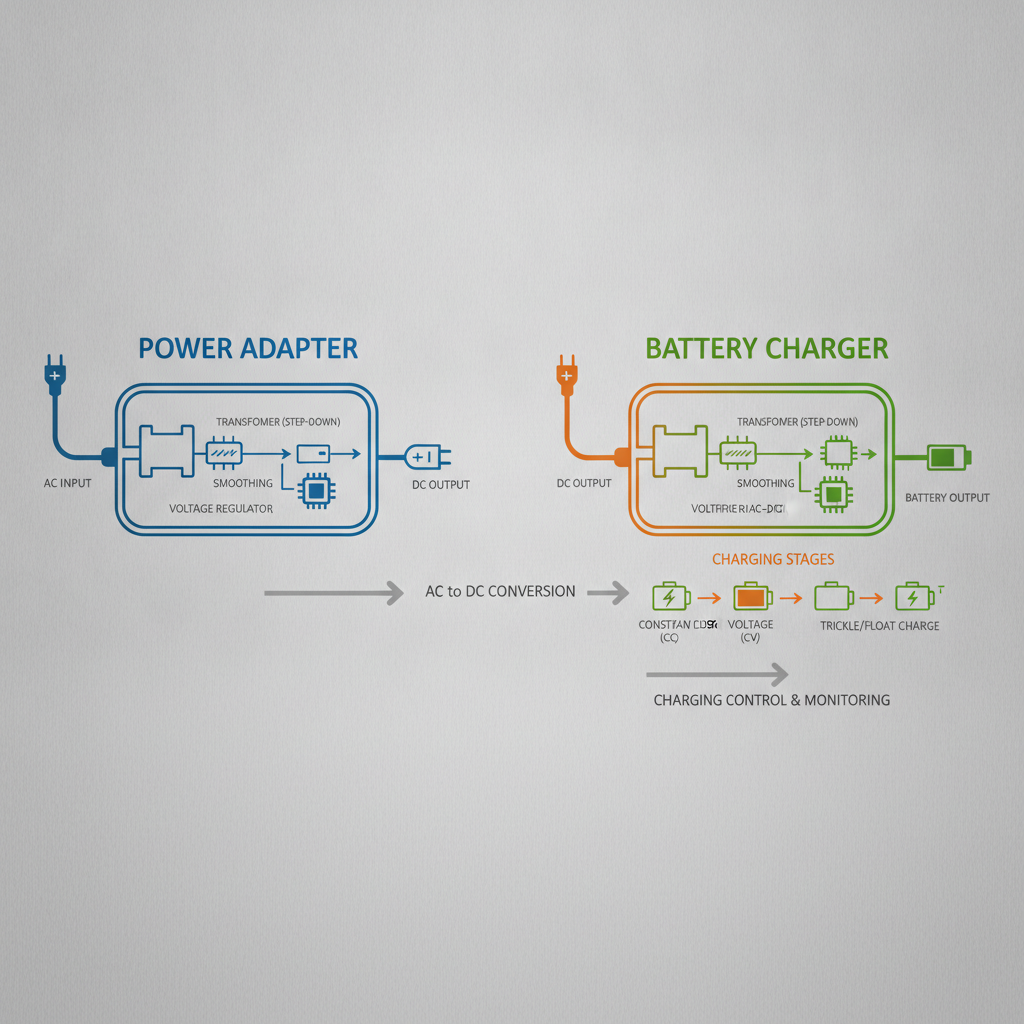
The fundamental difference is that a power adapter operates as a constant voltage source for immediate load consumption, while a battery charger acts as a variable current and voltage source to charge electrochemical cells. Understanding the distinction of a power adapter vs battery charger is vital for any hardware development cycle. A power adapter provides a stable, regulated output to supply direct energy to operational circuitry. In contrast, a battery charger must continuously adjust its output parameters to match the chemical state of an active energy storage unit.
Without this active regulation, connecting a raw power supply to an empty battery would lead to rapid degradation or thermal failure. Therefore, they are built with entirely different internal feedback control architectures.
How Do Their Internal Roles Differ?
Think about it: a battery cell is a dynamic, non-linear load that changes resistance continuously during charging. If you supply a fixed voltage without current limits, the battery will pull too much power.
- Power Supply: Delivers constant voltage to steady-state loads.
- Battery Charger: Regulates current flow dynamically based on the cell’s State of Charge (SoC).
- System Integration: Adapters power the device, while chargers replenish the power storage.
Choosing the Right Architecture
Selecting between these topologies depends entirely on where the charging logic resides. If your device has internal charge circuitry, a standard adapter is the optimal, cost-effective choice.
Key Takeaway: For B2B buyers, choosing a power adapter is ideal for direct device operation, whereas a standalone battery charger is mandatory for raw battery packs.
| Feature | Power Adapter | Battery Charger | |
|---|---|---|---|
| Primary Target | Direct System Loads | Battery Pack / Cells | |
| Output Nature | Constant Voltage (CV) | Constant Current (CC) / CV | |
| Feedback Loop | Voltage-centric | Voltage, Current, and Temp |
Now that we have established the core structural differences, let us examine how their internal conversion stages operate in practice.
② How Does a Power Adapter Work Compared With a Battery Charger?
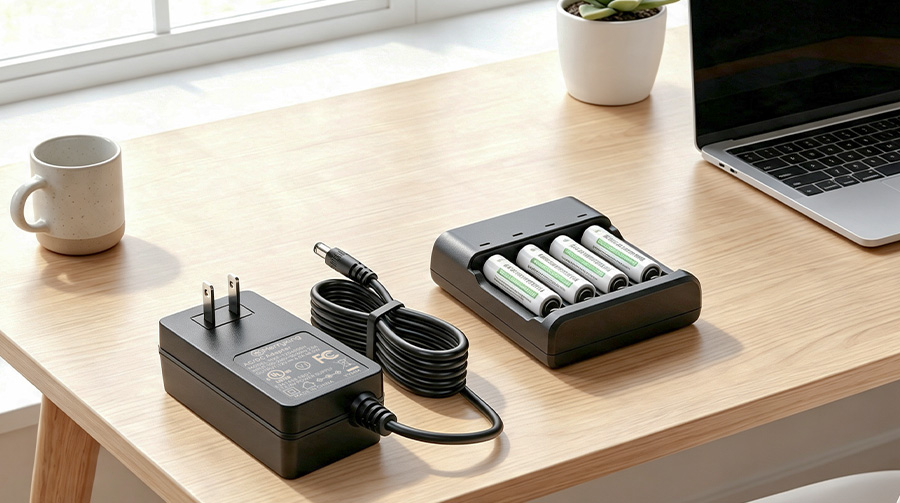
A power adapter functions by transforming high-voltage AC power into a single, stable DC voltage rail, whereas a battery charger executes a multi-stage charging algorithm to safely power electrochemical cells. When assessing how a power adapter vs battery charger processes electrical energy, the difference lies in the conversion pathway. A power adapter uses a switched-mode power supply (SMPS) topology to rectify and step down AC mains to a fixed DC level. This process maintains a tight voltage output regardless of current demands up to its limit.
A battery charger, on the other hand, utilizes a microcontroller to run a programmed charge profile. It constantly measures the voltage of the connected cell and modulates its switching duty cycle to protect the cell chemistry.
Can You Map Their Electrical Stages?
Let’s face it: standard power conversion is relatively straightforward, but cell charging is highly dynamic. The charging process requires multiple phases to achieve a safe, maximum capacity.
- Adapter Stage: Rectification, high-frequency switching, transformer step-down, and DC filtering.
- Charger Stage 1 (Bulk): Maximum current delivery while battery voltage climbs.
- Charger Stage 2 (Absorption): Constant voltage hold as the current decays.
- Charger Stage 3 (Float): A low-voltage trickle state to prevent self-discharge.
Key Takeaway: Understanding these operational stages helps you source the correct unit based on whether your product demands raw constant power or chemical cycle management.
| Step / Phase | Power Adapter | Battery Charger | |
|---|---|---|---|
| Conversion Type | AC-to-DC only | AC-to-DC with MCU Control | |
| Output Profiles | Flat static voltage | Dynamic multi-stage curves | |
| Final State | Continuous operation | Automated shutdown / float |
Managing these complex stages requires highly specialized control feedback loops, which we will analyze next.
③ Why Does a Battery Charger Need More Control Than a Power Adapter?
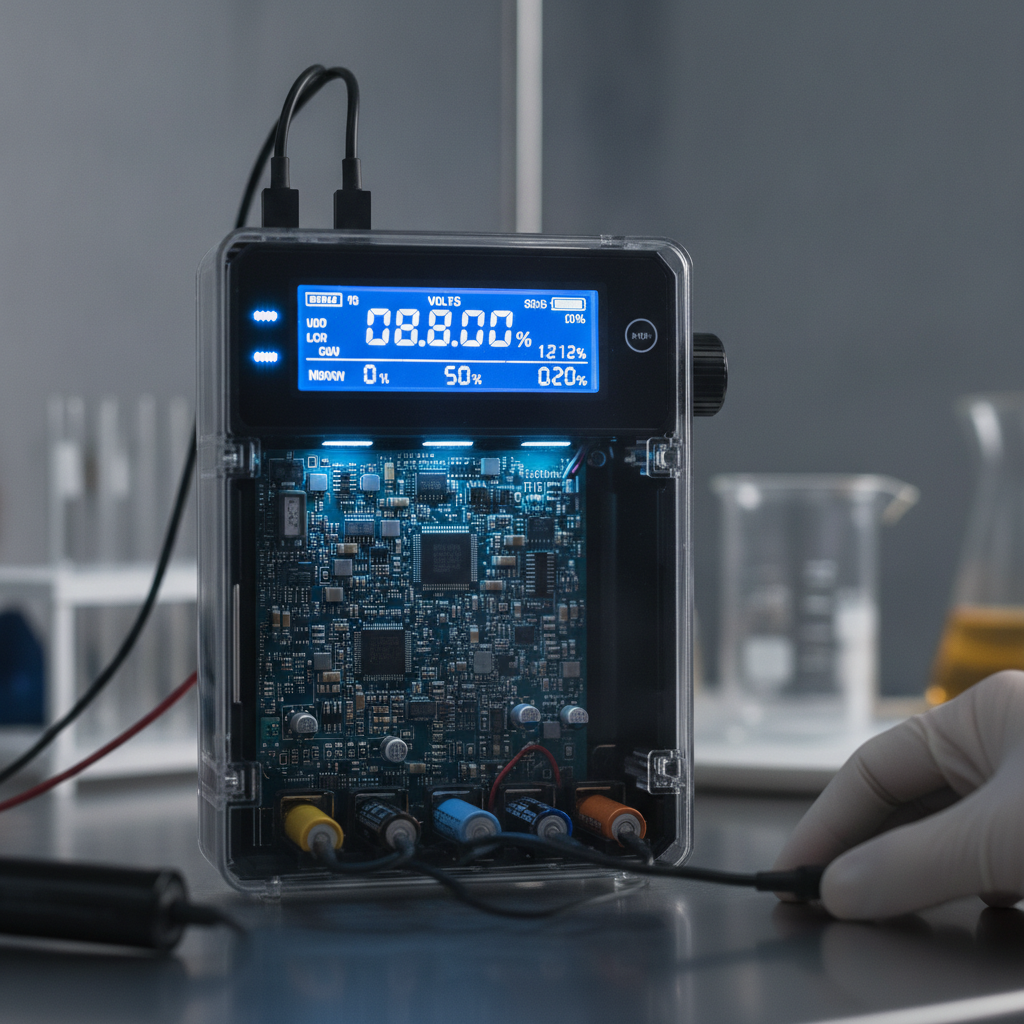
A battery charger requires more control than a power adapter because chemical cells represent an unstable, non-linear load that can overheat or catch fire if charged with unrestricted voltage or current. When analyzing a power adapter vs battery charger , control complexity is the most significant engineering differentiator. A power adapter relies on simple analog feedback to keep its output voltage within a tight tolerance band. A battery charger must monitor temperature, voltage, and current simultaneously to adjust to changing cell impedances.
Without these strict controls, the cell could easily enter a state of thermal runaway. This is why smart chargers employ specialized chips or microcontrollers to manage power delivery.
What Happens Without Active Control?
But wait, there is more: applying unregulated power to lithium or lead-acid batteries will cause catastrophic failures. Overcharging leads to internal plating and short-circuits that destroy your pack.
- Voltage Tracking: Prevents exceeding the maximum terminal threshold.
- Current Limiting: Avoids overheating during the high-current bulk phase.
- Thermal Cutoffs: Immediately halts current if temperature limits are breached.
Key Takeaway: Investing in highly controlled charger circuitry is essential for ensuring product safety and preventing costly liability issues in the field.
| Control Element | Power Adapter | Battery Charger | |
|---|---|---|---|
| Internal Processor | Analog PWM controller | Microprocessor (MCU / IC) | |
| Safety Shutoffs | Overcurrent, short-circuit | Overvoltage, thermal, reverse polarity | |
| Voltage Accuracy | ±2% to ±5% | Extremely high (±0.5%) |
This level of control determines the specific applications where each device can be safely integrated.
④ What Are the Main Applications of a Power Adapter vs Battery Charger?
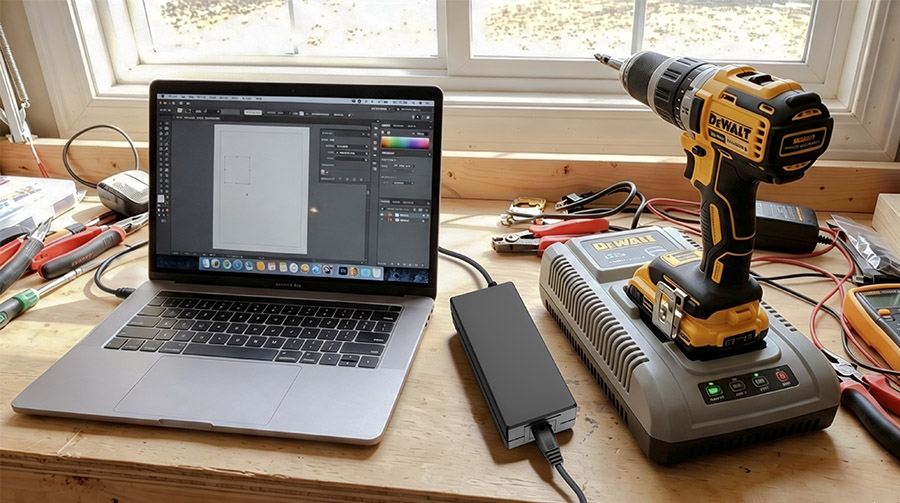
Power adapters are primarily used to run stationary, plugged-in devices like routers and monitors, whereas battery chargers are required to replenish portable, battery-powered equipment like power tools and electric vehicles. Selecting the correct application layout for a power adapter vs battery charger depends on whether your system contains a built-in energy storage unit. Power adapters provide continuous external power to systems that run immediately on utility electricity. On the other hand, battery chargers are designed for cordless devices that run on battery power when unplugged.
Using the wrong component for your target application will lead to either an inoperable device or an unsafe battery charging state. Thus, matching the power architecture to the product’s operational model is critical.
Where Are They Deployed in the Industry?
Here is the real kicker: many modern portable devices hide their battery chargers inside the chassis, using a power adapter to feed the internal circuit. However, heavy-duty industrial systems still require robust external chargers.
- Adapter Applications: Network routers, security cameras, point-of-sale systems, and computer monitors.
- Charger Applications: Cordless power tools, industrial e-bikes, warehouse AGVs, and medical cart batteries.
- Hybrid Applications: Laptops and smartphones containing internal charging ICs.
Key Takeaway: For B2B procurement, confirm whether your product has internal charge-management circuitry before sourcing a power supply.
| Application Type | Primary Power Component | Setup Complexity | |
|---|---|---|---|
| Direct Wall-Powered | Power Adapter | Low (Direct DC rail) | |
| Standalone Battery Pack | External Battery Charger | High (BMS Integration) | |
| Mobile Device with Internal Charging | Power Adapter | Medium (Adapter + Internal IC) |
To understand how these applications perform, we must look at the physical differences in voltage and current outputs.
⑤ How Do Output Voltage and Current Differ Between a Power Adapter vs Battery Charger?
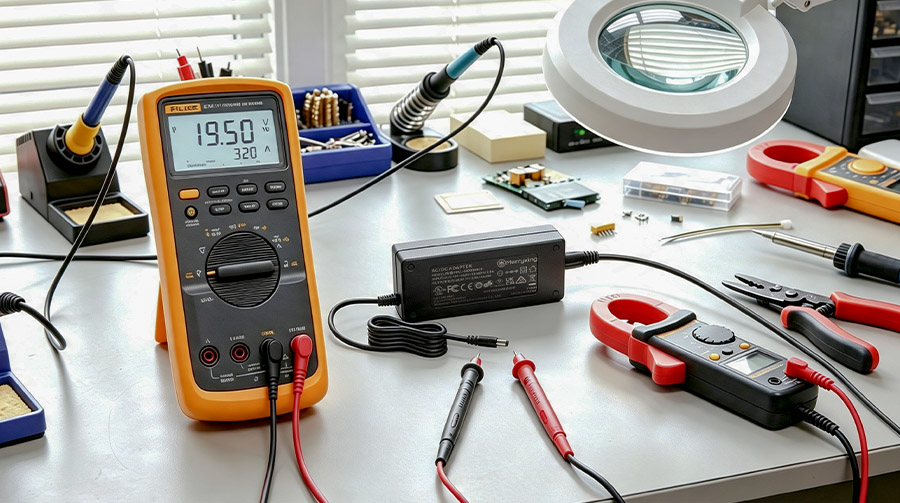
A power adapter provides a steady, flat output voltage across its entire load range, while a battery charger delivers a dynamic voltage and regulated current output that varies according to the charging stage. When analyzing the electrical profiles of a power adapter vs battery charger , the key lies in how they handle load variation. A power adapter maintains its nominal rated voltage (such as 12V or 24V) stable even as the device draws more current. This flat line output is essential for powering sensitive digital microchips that require steady voltage rails.
In contrast, a battery charger relies on a dynamic curve where both voltage and current change over time. It limits current to prevent cell damage and allows voltage to drift upward as the battery fills.
What Does Their Output Look Like Under Load?
Think about it: a standard power supply treats an overcurrent draw as an electrical fault and shuts off immediately to prevent damage. A charger, however, views maximum current draw as a standard starting state and regulates it actively.
- Adapter Load Behavior: Steady voltage; shuts down if current exceeds maximum rating.
- Charger Load Behavior: Adjusts voltage dynamically to force a specific, safe current into the cell.
- Noise and Ripple: Power supplies focus on low-noise outputs, whereas chargers prioritize power throughput.
Key Takeaway: Ensure your development team selects components based on the load profile of the hardware; steady loads need adapters, while dynamic cells need chargers.
| Output Parameter | Power Adapter | Battery Charger | |
|---|---|---|---|
| Voltage Curve | Flat / Static | Rising / Multi-stage | |
| Current Behavior | Demand-driven (up to limit) | Constant Current regulated | |
| Overload Response | Shuts down (Hiccup/Foldback) | Restricts and regulates current |
This output regulation becomes even more safety-critical when interacting with battery management systems.
⑥ Why Is Battery Management Important in a Battery Charger?
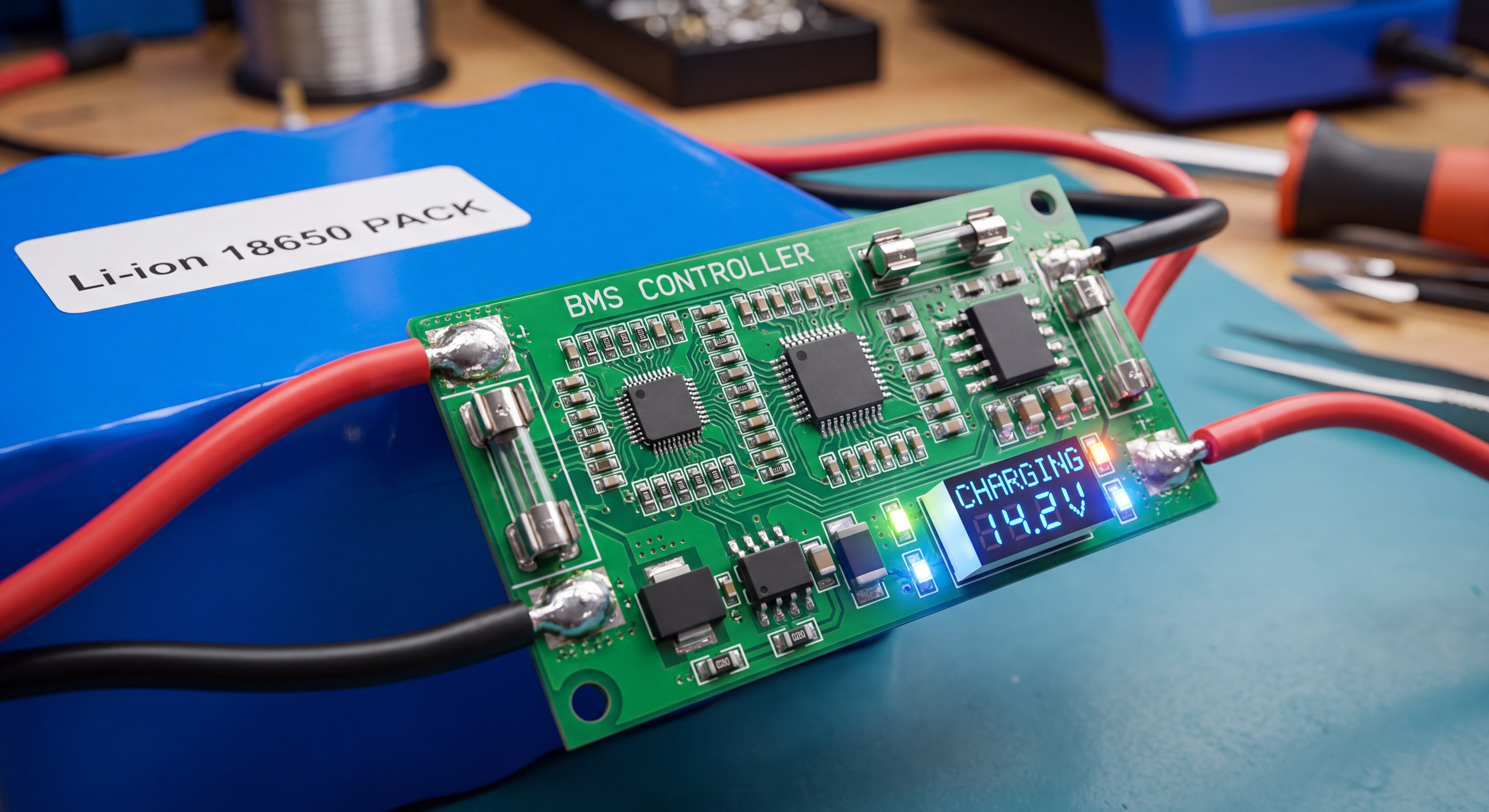
Battery management is essential in a battery charger because it protects individual cells from overcharging, balances cell voltages, and monitors temperatures to prevent thermal runaway. Evaluating the safety architecture of a power adapter vs battery charger highlights the importance of the Battery Management System (BMS). A standard power adapter operates blindly, unaware of the condition of the downstream device. A battery charger must coordinate with the BMS to monitor individual cell status and prevent overcharging.
This communication is usually carried out via digital protocols such as CAN bus or I2C. This link allows the charger to dial back output instantly if a single cell begins to fail.
How Does the BMS Coordinate Charging?
Let’s face it: high-capacity lithium-ion battery packs are highly volatile if handled incorrectly. A smart battery charger works hand-in-hand with the BMS to balance cell states and extend system lifespan.
- Cell Balancing: Equalizes the voltage across all series-connected cells.
- Thermal Protection: Halts the charging cycle if cell temperatures rise too quickly.
- Digital Handshakes: Verifies pack chemistry and capacity before initiating power flow.
Key Takeaway: For industrial and high-voltage projects, always specify chargers that can actively communicate with your pack’s BMS.
| Management Feature | Standard Power Supply | Smart Charger with BMS | |
|---|---|---|---|
| Cell-Level Control | None | Active monitoring and balance | |
| Protocols | None | CAN bus, I2C, SMBus | |
| Lifetime Extension | Poor (if used to charge) | Excellent (custom profiles) |
Understanding this coordination explains why attempting to bypass a dedicated charger is extremely dangerous.
⑦ Can a Power Adapter Be Used Instead of a Battery Charger?
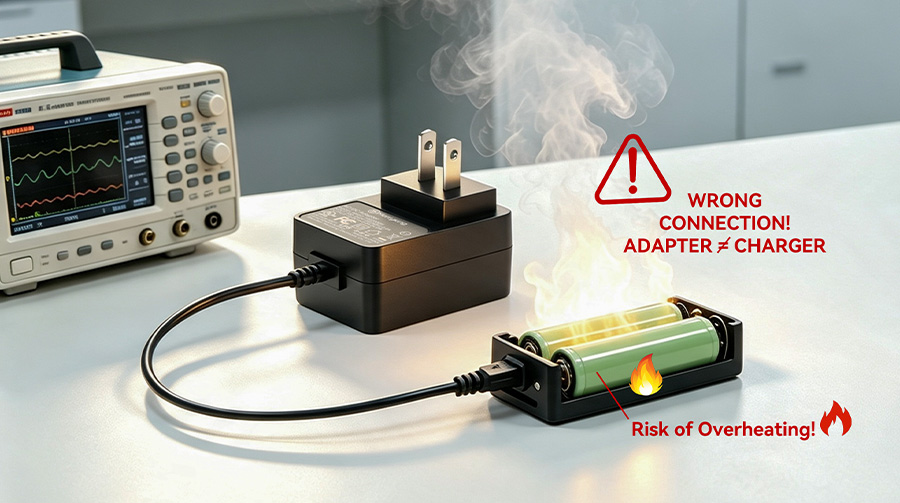
No, you cannot use a power adapter to charge a bare battery cell directly because the adapter lacks the active current limiting and charge-termination features required to prevent thermal runaway. When considering a power adapter vs battery charger , design teams often ask if they can substitute one for the other to save costs. The strict answer is that you can only use an adapter if your end device contains an onboard charging IC. Connecting an external power supply directly to a lithium-ion cell is an immediate fire hazard.
The internal charger IC acts as the gatekeeper, taking the constant voltage from the adapter and converting it into a safe CC/CV charge cycle. Without this gatekeeper, the battery will pull excessive current and fail catastrophically.
When Is an Adapter Acceptable?
But wait, there is more: this is exactly how your smartphone and laptop function. The ‘charger’ plugged into the wall is actually just a power adapter feeding a highly sophisticated internal charging system.
- Direct-to-Cell: Highly dangerous; causes overcharging and fires.
- Device with Onboard IC: Safe and standard; the adapter provides the raw power rail.
- Removable Battery Packs: Requires a dedicated external battery charger.
Key Takeaway: Never eliminate the charger circuit from your system design; if it is not inside the device, it must be in the external charging brick.
| Design Scenario | Component Required | Safety Certification Path | |
|---|---|---|---|
| Bare Cell Charging | Dedicated Battery Charger | UL 1564 / IEC 60335-2-29 | |
| Onboard Charger IC | Power Adapter | IEC 62368-1 | |
| Stationary / Corded | Power Adapter | IEC 62368-1 |
Both designs require strict adherence to regulatory safety protections to safeguard users and equipment.
⑧ What Safety Protections Should a Power Adapter vs Battery Charger Include?
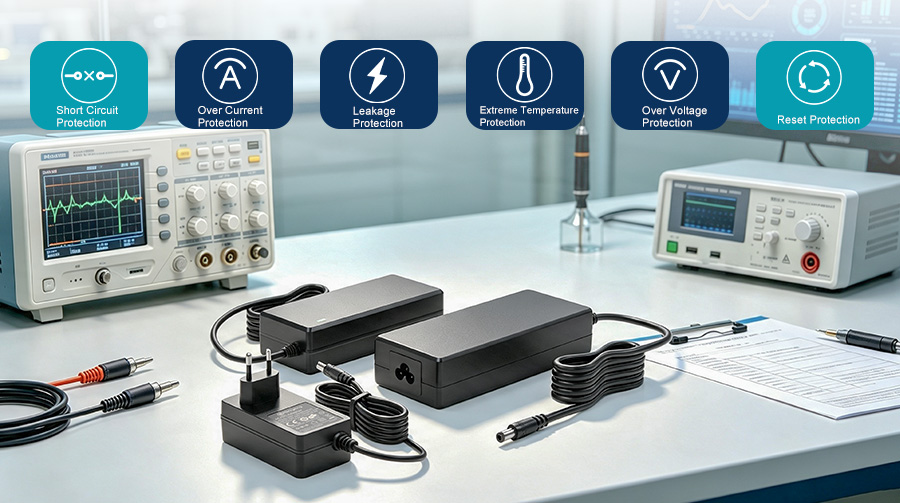
A power adapter requires standard protections like overvoltage, overcurrent, and short-circuit control, while a battery charger must also include reverse polarity, over-temperature, backcurrent prevention, and safety timers. Safety standards represent the most critical compliance hurdle when comparing a power adapter vs battery charger for international markets. Power adapters focus heavily on protecting the end-user and downstream electronics from AC mains power surges. They isolate high AC voltages from the low DC output, shutting down instantly if a short circuit is detected.
Battery chargers must handle these same risks while also managing the chemical hazards of the battery itself. Because batteries hold a massive amount of stored energy, the charger must prevent current from flowing backwards into the power grid.
What Protections Are Mandatory?
Here is the real kicker: a simple short-circuit protection is not enough when dealing with an active battery pack. If you insert a battery backward, a charger without reverse polarity protection will burn out instantly.
- Adapter Protection Suite: Overvoltage (OVP), Overcurrent (OCP), and Short-Circuit (SCP).
- Charger Protection Suite: OVP, OCP, SCP, plus Reverse Polarity (RPP).
- Safety Timers: Automatically cuts power if the cell does not reach full capacity in a set time.
Key Takeaway: Verify that your chosen manufacturer implements dual-layer safety circuits to protect your system from hardware failures and human error.
| Protection Mechanism | Power Adapter | Battery Charger | |
|---|---|---|---|
| Short-Circuit Protection | Mandatory (Hiccup mode) | Mandatory (Latching/Current limit) | |
| Backcurrent Prevention | Not required | Mandatory (Blocks reverse flow) | |
| Thermal Sensing | Internal only | Dual (Internal + External battery sensor) |
These mandatory protections are key elements that B2B buyers must evaluate during the sourcing process.
⑨ What Should B2B Buyers Consider When Choosing a Power Adapter vs Battery Charger?
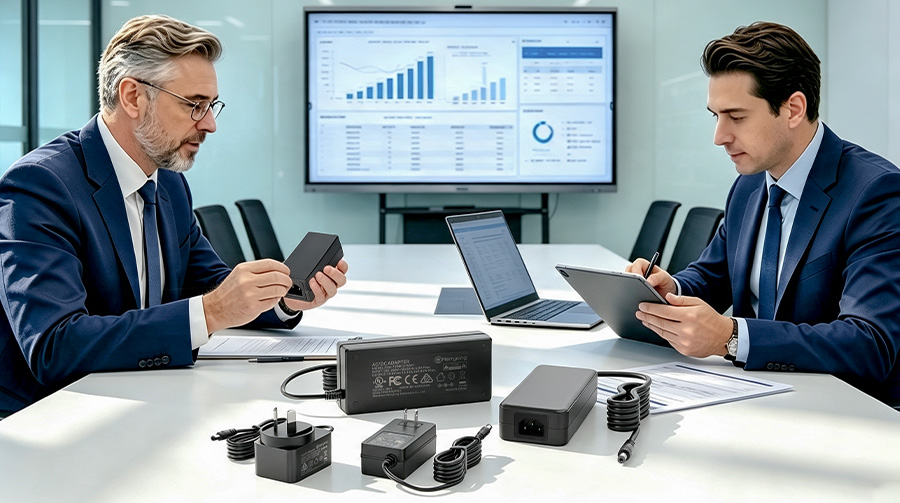
B2B buyers must prioritize international safety certifications, energy efficiency compliance, total cost of ownership, and manufacturer reliability when selecting a power adapter or battery charger. When procurement managers evaluate a power adapter vs battery charger for a new product launch, compliance is the first line of defense. Sourcing uncertified power components is a major product risk that can cause custom seizures or delayed launches. You must ensure the manufacturer provides transferable certificates for your target markets.
Furthermore, analyzing the long-term reliability of the component is vital to avoid high warranty return rates. Choosing a high-quality partner ensures steady mass production quality from the first unit to the ten-thousandth.
How Do You Verify Sourcing Specs?
Think about it: saving a few cents on a cheap power brick can end up costing thousands of dollars in product recalls. Look for suppliers that use tier-one capacitors and offer solid MTBF ratings.
- Safety Certs: Look for IEC/EN 62368-1 for adapters and UL 1564 / IEC 60335 for chargers.
- Efficiency: Confirm compliance with US DoE Level VI and EU CoC Tier 2.
- Build Quality: Verify the manufacturer uses high-temperature Japanese capacitors.
Key Takeaway: For B2B procurement, prioritize pre-certified, high-MTBF units to ensure smooth market entry and minimize post-launch warranty costs.
| Selection Metric | Power Adapter Priority | Battery Charger Priority | |
|---|---|---|---|
| Compliance Standards | IEC 62368-1, CE, UL, FCC | UL 1564, IEC 60335-2-29, cell safety | |
| Efficiency Level | DoE Level VI / CoC Tier 2 | High conversion efficiency (>90%) | |
| Sourcing Lifecycle | Standard mass production stability | Custom firmware profiles for cells |
To match these rigorous standards, B2B hardware teams often opt for customized solutions tailored to their specific products.
⑩ How Can Manufacturers Customize a Power Adapter or Battery Charger Solution?
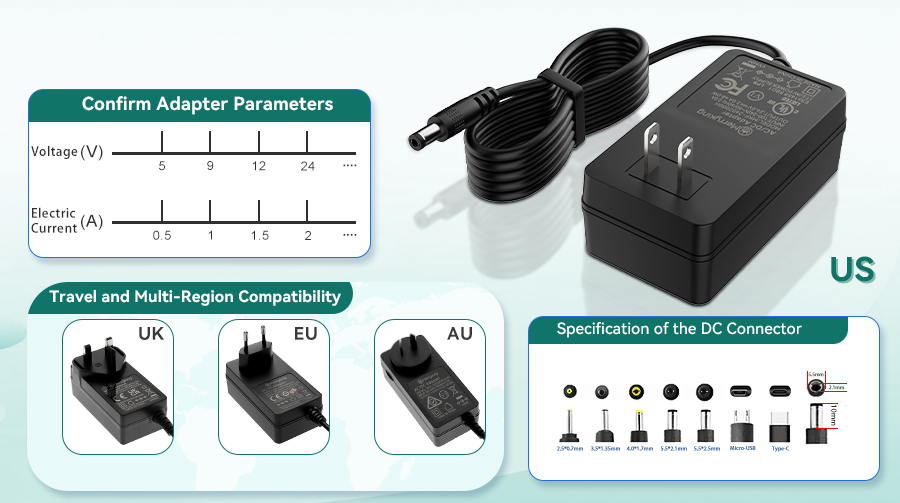
Manufacturers can customize electrical firmware parameters, physical connector plugs, and ruggedized mechanical enclosures to tailor power adapters or battery chargers for unique industrial applications. Partnering with a flexible manufacturer to build a custom power adapter vs battery charger provides your product with a distinct competitive edge. You can tune voltage and current limits to match non-standard system demands perfectly. This optimization improves overall energy efficiency and prevents component overheating.
Mechanical modifications are also vital for rugged settings. Enclosures can be upgraded with dustproof or waterproof materials to withstand harsh industrial environments.
What Can Be Customized?
Let’s face it: standard off-the-shelf power supplies are rarely a perfect fit for proprietary medical or industrial hardware. Tailoring the casing, cables, and charging curves guarantees a reliable user experience.
- Electrical Specs: Adjust charging voltage levels and configure multi-stage charge profiles.
- Physical Connectors: Choose waterproof, vibration-proof, or custom magnetic plugs.
- Branding & Enclosures: Apply custom colors, pad-printed company logos, and custom labels.
- Ingress Protection: Upgrade casings up to IP65 or IP67 ratings for outdoor use.
Key Takeaway: Working directly with an experienced OEM/ODM factory like Merryking guarantees that your power supplies align perfectly with your hardware’s performance profile.
| Customization Option | Power Adapter Capability | Battery Charger Capability | |
|---|---|---|---|
| Firmware Tuning | Fixed output rail adjustment | Multi-stage charging algorithms, CAN bus | |
| Mechanical Protection | Standard casing up to IP44 | Ruggedized casing up to IP67 | |
| Connection Options | Barrel jacks, USB-C, custom connectors | Heavy-duty copper leads, temperature sensors |
Having explored these options, let us address common practical questions that buyers face during selection.
Frequently Asked Questions
Can I charge a battery directly with a 24V power adapter if the battery pack is also rated for 24V?
No, you should never connect a standard power adapter directly to a bare battery. Power adapters lack the critical current-limiting circuits required to safely manage a battery’s low initial impedance, which can lead to overheating or fire.
How do I know if my industrial device needs an external battery charger or just a power adapter?
It depends on where the charge control circuitry is located. If your device has an integrated, internal charging controller on its main PCB, you only need a standard power adapter; if your battery pack is removable and has no onboard controller, you require an external charger.
What’s the best safety certification I should look for when importing power components to the US?
UL certification is the gold standard. For power adapters, look for safety certificates under UL/IEC 62368-1, whereas dedicated battery chargers must comply with UL 1564 or UL 60335 to clear customs smoothly.
Can I use a smart battery charger as a constant-voltage power supply to run a device?
Generally, no. Most smart battery chargers require a minimum voltage detection from an attached battery before they will output any power. If you connect a passive device, the charger will typically detect a fault and remain off.
How do I know if a power manufacturer is a genuine direct factory rather than a trading company?
Yes, you can verify this by checking their production capacity and certification co-listings. Genuine factories like Merryking own dual-factory production bases in Shenzhen and Dongguan, allowing them to provide transferable global certifications directly.
Conclusion
Selecting between a power adapter and a battery charger is a make-or-break decision for your hardware’s lifecycle, safety, and regulatory pathway. By clearly understanding their structural and electrical differences, you can eliminate design failures, streamline compliance, and bring robust products to market.
Whether you need stable, high-efficiency wall-mount and desktop power supplies or complex, firmware-customized charging systems, Merryking provides the direct-factory engineering expertise you require. We solve your supply chain challenges by delivering pre-certified, batch-consistent OEM/ODM power solutions with a three-stage quality control system.
Are you ready to optimize your system’s power performance? To discuss your custom electrical parameters and accelerate your global product launch, contact us to work directly with our engineering team today.