Using a non-original power adapter introduces critical safety risks including electrical fires, catastrophic device failure, and severe battery degradation. If you have ever noticed that your expensive electronic device gets unusually hot or starts acting weird during charging, you are already experiencing the warning signs of poor power delivery. Over time, ignoring these symptoms can escalate from minor operational glitches to costly equipment replacements or even devastating office fires. Fortunately, protecting your B2B hardware investment is simple: you must prioritize sourcing reliable, certified power adapters from reputable manufacturing partners.
① What is the difference between branded and generic adapters?
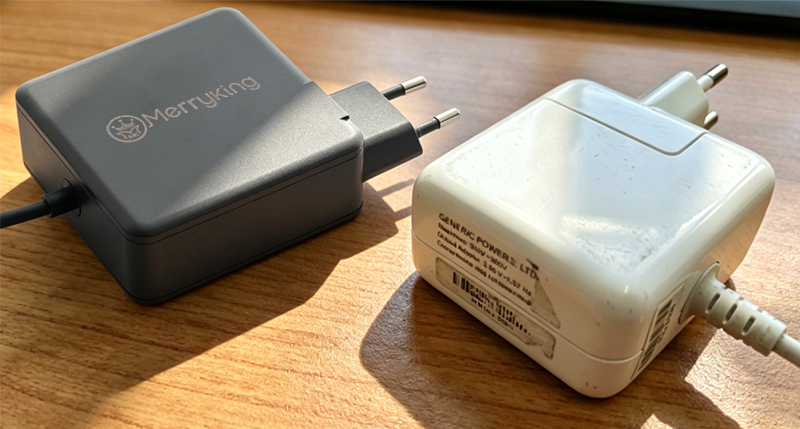
Branded adapters use high-grade components and strict quality controls, whereas generic options cut corners on safety engineering and raw materials. When you buy a certified, high-quality power supply, you are paying for robust circuit design, premium capacitors, and reliable thermal management. In contrast, choosing a generic non-original power adapter means you risk exposing your valuable electronics to inconsistent current and sub-par materials. These cheap alternatives are built to meet the lowest possible price point rather than rigorous safety standards.
Why do component standards matter for B2B operations?
Think about it: If your company deploys hundreds of devices, a single component failure can cause massive downtime. Original and certified adapters feature Japanese-made capacitors and heavy-duty copper wiring designed to withstand years of continuous commercial use.
- Branded adapters: Use premium, flame-retardant plastic housings and thick copper coils.
- Generic adapters: Rely on recycled plastics and thin, fragile aluminum wiring.
How does design quality impact long-term device health?
But that is not all. Cheaper alternatives lack the precision engineering required to maintain stable thermal profiles under full load. This lack of structural integrity leads to premature wear of both the adapter and the connected B2B hardware.
- Stable thermal dissipation prevents heat buildup in commercial workstations.
- Proper strain relief on cables prevents fraying and internal short circuits.
| Feature / Metric | Branded OEM Adapter | Generic Non-Original Adapter | |
|---|---|---|---|
| Capacitor Quality | High-Grade (Japanese/Taiwanese) | Low-Grade Recycled | |
| Housing Material | UL 94V-0 Flame Retardant Plastic | Non-Rated ABS Plastic | |
| Copper Coil Thickness | Heavy-duty Pure Copper | Thin Copper-Clad Aluminum | |
| Warranty & Support | Full Manufacturer Warranty | None |
This comparison highlights why investing in professional-grade power delivery components is essential for operational longevity.
Key Takeaway: Branded power adapters prioritize safety and durable materials, while cheap generic options compromise on core engineering to lower production costs.
② How do non-original adapters cause severe electrical sparks?
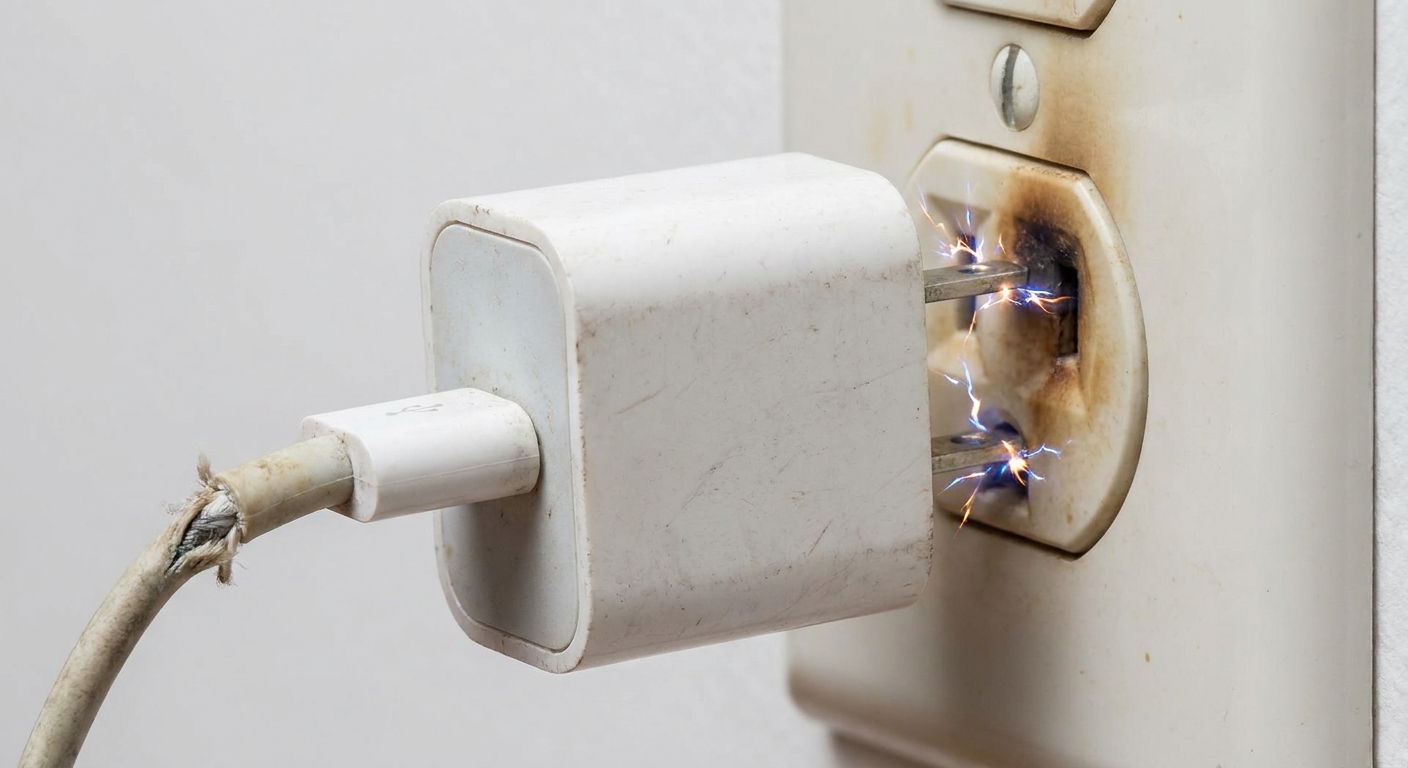
Non-original adapters cause electrical sparks due to poor insulation spacing and substandard internal clearance between high-voltage and low-voltage circuits. This physical proximity allows electrical current to jump across gaps, creating a high-energy arc that damages both the wall outlet and the plug. Using an uncertified non-original power adapter increases the probability of these high-voltage spikes escaping directly into your workspace. Without proper gap spacing, a minor surge on your main line can instantly turn into an explosive spark hazard.
What causes arcing in cheap wall chargers?
Here is the key: Inadequate physical separation between the primary and secondary circuits on the PCB is the main driver of electrical arcing. When the voltage rises, the air gap fails to contain the electrical charge, resulting in visible sparks and scorched outlets.
- Creepage distance: The shortest path along the surface of an insulating material.
- Clearance distance: The shortest path through air between two conductive parts.
What are the consequences of frequent outlet sparking?
What is the catch? Every time your adapter sparks upon plugging it in, it degrades the metal contacts inside your wall outlets. Over time, this degradation increases resistance, which leads to localized heat generation and eventually a localized electrical fire.
- Degraded wall sockets require expensive commercial electrical repairs.
- Arcing can damage sensitive internal power components inside your connected equipment.
| Metric | Certified Adapter | Uncertified Adapter | |
|---|---|---|---|
| Minimum Creepage Distance | ≥ 6.0 mm (industry standard) | Often < 3.0 mm | |
| Wall Socket Degradation Risk | Negligible | Extremely High | |
| Arcing Prevention Circuitry | Integrated | Completely Absent |
Understanding the physical limits of circuit isolation explains why cheap designs present immediate physical dangers.
Key Takeaway: Insufficient internal spacing in low-quality adapters leads to dangerous electrical arcing and severe socket damage.
③ Why does a cheap power supply trigger device battery errors?
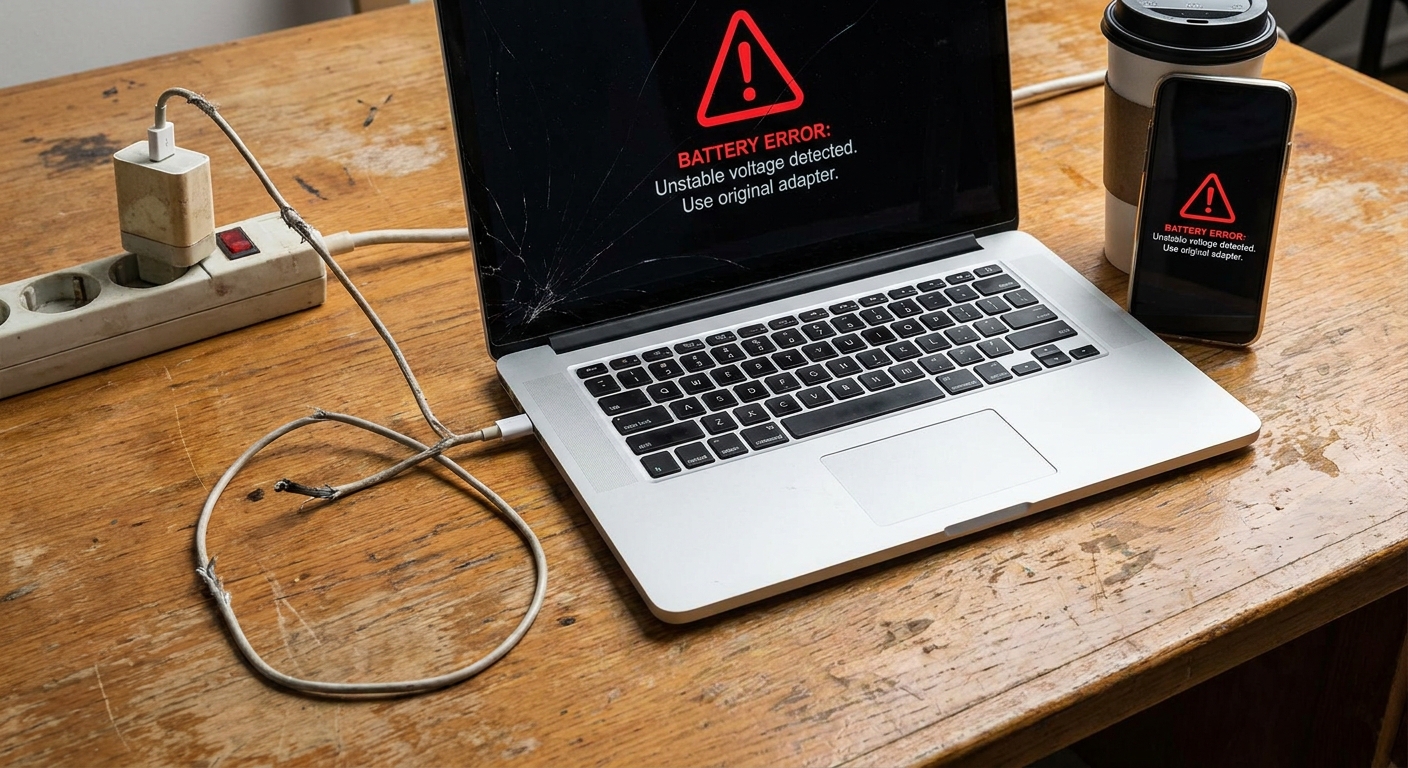
Cheap power supplies trigger device battery errors because they lack the communication protocols and clean power output required by modern battery management systems. These systems monitor incoming current closely, and any variation can lead to warning screens or disabled charging cycles. Sourcing a cheap non-original power adapter usually results in high voltage ripple that confuses your device’s internal charging controller. This constant fluctuation eventually forces the operating system to reject the charger entirely to protect the hardware.
How does voltage ripple degrade lithium-ion batteries?
Think about it: Your device’s battery requires a smooth, continuous stream of direct current to charge safely and maintain its structural integrity. Cheap adapters deliver a highly unstable signal filled with micro-spikes that degrade the battery’s chemistry prematurely.
- High voltage ripple: Causes accelerated lithium plating on the anode.
- Unstable current: Triggers excessive internal heat within the battery cells.
Why do devices display non-compliant charger warnings?
But that is not all. Modern commercial laptops and tablets utilize proprietary handshake protocols to verify that the connected charger is safe. Cheap copycats try to bypass this check with basic hardware spoofing, which often fails after software updates.
- Bypassed protocols can trigger operating system throttle states, slowing down performance.
- Failed handshakes may disable fast-charging capabilities completely.
| Battery Metric | OEM/Certified Power | Cheap Non-Original Power | |
|---|---|---|---|
| Voltage Ripple (mVp-p) | < 50 mV (Stable) | > 200 mV (Unstable) | |
| Battery Life Cycle Retention | 80%+ after 500 cycles | < 50% after 200 cycles | |
| Handshake Communication | Fully Integrated | Missing or Spoofed |
A stable power signal is mandatory for protecting expensive lithium batteries from swelling and early failure.
Key Takeaway: Unstable power signals and lack of proper communication protocols in generic chargers trigger immediate battery warnings and long-term capacity loss.
④ Can a low-quality charger become a serious fire hazard?
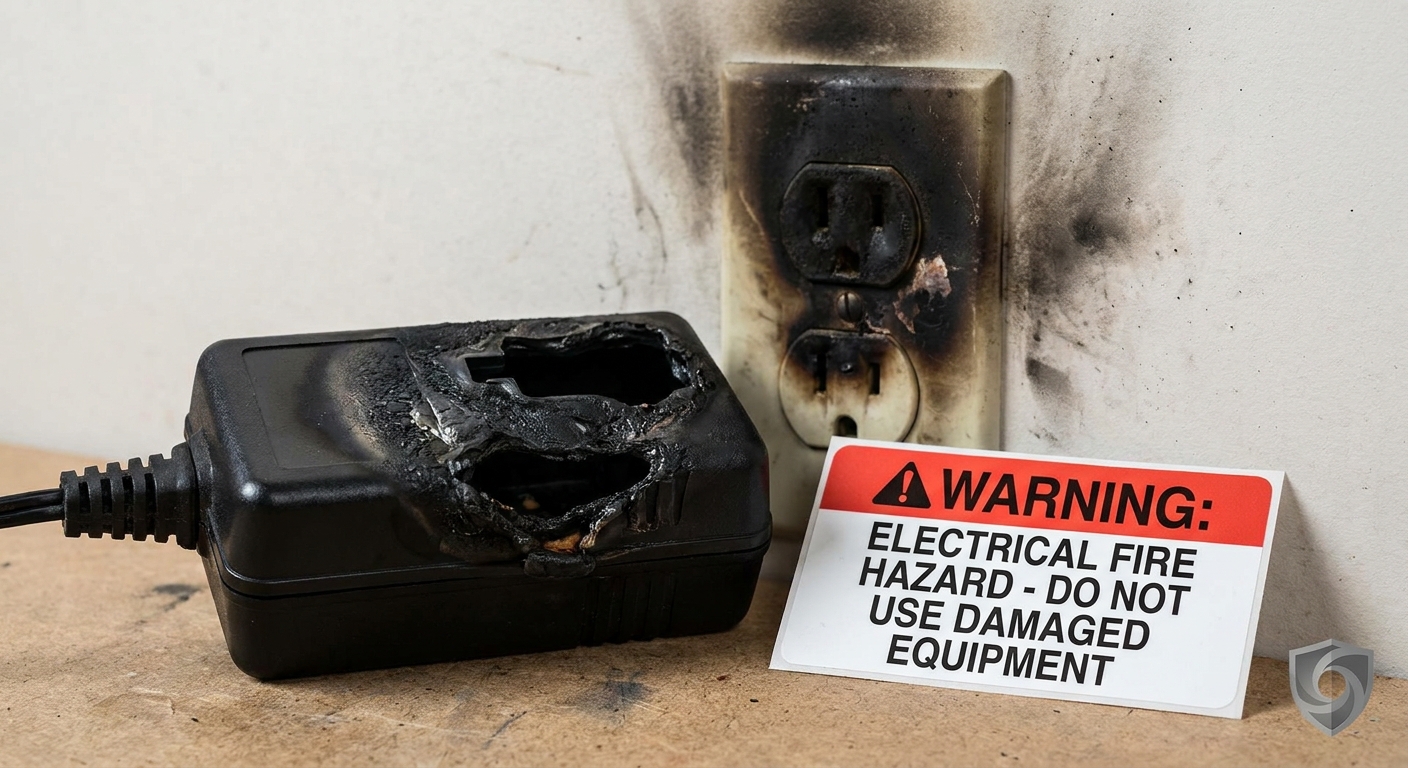
Low-quality chargers are a major cause of commercial electrical fires because they lack over-temperature protection and use highly flammable casing materials. When an internal component shorts out, the unit can rapidly heat up to over two hundred degrees Celsius within seconds. Deploying a cheap non-original power adapter across your office means introducing unchecked ignition sources into carpeted cubicles and server rooms. Without automatic thermal shutdown mechanisms, a simple component failure will cause the adapter to melt and catch fire.
Why do cheap plastics fuel electrical fires?
Here is the key: Certified manufacturers use specialized flame-retardant plastics designed to self-extinguish when exposed to extreme heat. Low-end factories use cheap ABS plastics that act as fuel, melting into a burning liquid that spreads fire quickly.
- UL 94 V-0: Plastic must self-extinguish within ten seconds of flame application.
- Non-rated plastics: Continue to burn and drip flaming plastic, igniting surrounding objects.
How does the absence of thermal shutdown cause disasters?
What is the catch? High-quality adapters monitor their own internal temperature and cut off power immediately if they get too hot. Budget adapters will continue to draw power from the wall socket even as their internal components melt into a molten mass.
- Overcurrent situations lead to immediate thermal runaway in uncertified designs.
- Lack of internal thermal fuses leaves the device completely unprotected.
| Fire Safety Metric | Certified Power Adapter | Low-Quality Non-Original | |
|---|---|---|---|
| Casing Flammability Rating | UL 94 V-0 (Self-Extinguishing) | Non-rated / Highly Flammable | |
| Thermal Fuse Protection | Dual Thermal Fuses Integrated | None (Hardwired) | |
| Maximum Operating Temp | < 65°C | Can exceed 150°C under load |
Choosing adapters built with flame-retardant materials is the single most important decision for office fire prevention.
Key Takeaway: The combination of flammable plastics and absent thermal protection makes low-quality adapters a primary source of catastrophic electrical fires.
⑤ Why is unstable voltage output dangerous for electronics?
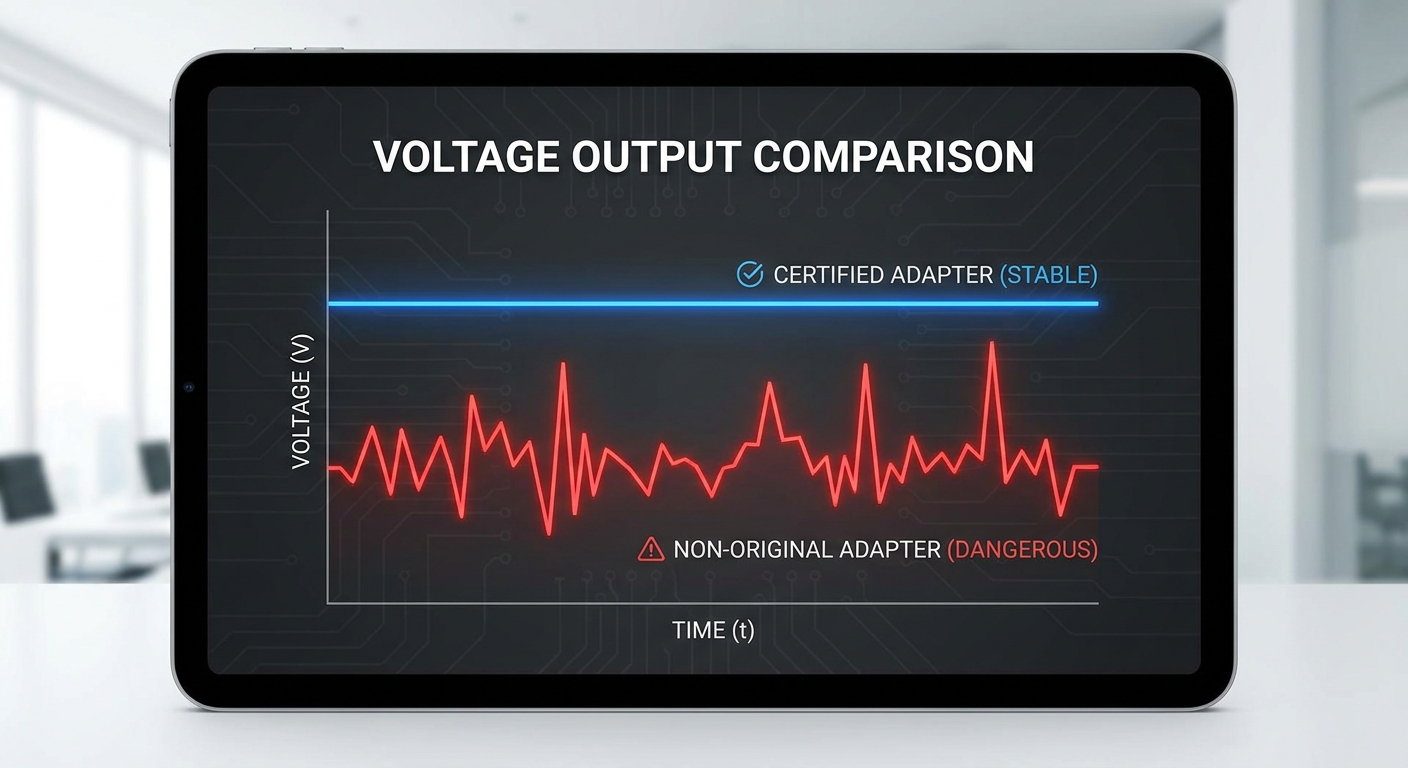
Unstable voltage output damages sensitive microprocessors and integrated circuits that require precise, steady voltage to function without error. When the voltage spikes above the rated limit, it can blow out tiny transistors on your device’s motherboard, rendering the entire system useless. A poorly engineered non-original power adapter fails to regulate output under fluctuating load conditions, leading to dangerous voltage sags and surges. This continuous electrical stress weakens the delicate silicone components inside your hardware, causing sudden system crashes and data loss.
What are the effects of micro-surges on microchips?
Think about it: A microchip operating at 1.2 volts can be permanently damaged by a sudden spike of just 2.0 volts. Professional power supplies utilize active voltage regulators to keep output strictly within a tight three-percent tolerance window.
- Voltage spikes: Overwhelm internal capacitors and burn out copper traces.
- Voltage sags: Cause sudden logic errors, data corruption, and spontaneous reboots.
How does a lack of active regulation destroy hardware?
But that is not all. Generic adapters rely on passive regulation, meaning they cannot adapt to sudden changes in your building’s electrical grid. If an industrial machine elsewhere in your facility starts up, the resulting line surge passes straight through a cheap adapter into your computer.
- Active line conditioning filters out common grid noise and surges.
- Overvoltage protection (OVP) acts as an instantaneous firewall against high-voltage surges.
| Electrical Metric | Certified Power Supply | Unregulated Non-Original | |
|---|---|---|---|
| Voltage Tolerance Range | ±3% (Highly Stable) | ±15% or worse (Highly Unstable) | |
| Overvoltage Protection | Shuts down at +10% over limit | No protection (passes surge) | |
| Line Noise Filtration | Integrated EMI & surge filters | Bare circuit, no filtration |
Ensuring your power supplies feature active regulation protects your expensive digital assets from silent electrical degradation.
Key Takeaway: Unregulated voltage from low-end adapters degrades silicon microchips over time, leading to unexpected device failures and data corruption.
⑥ What hidden defects exist inside cheap circuit boards?
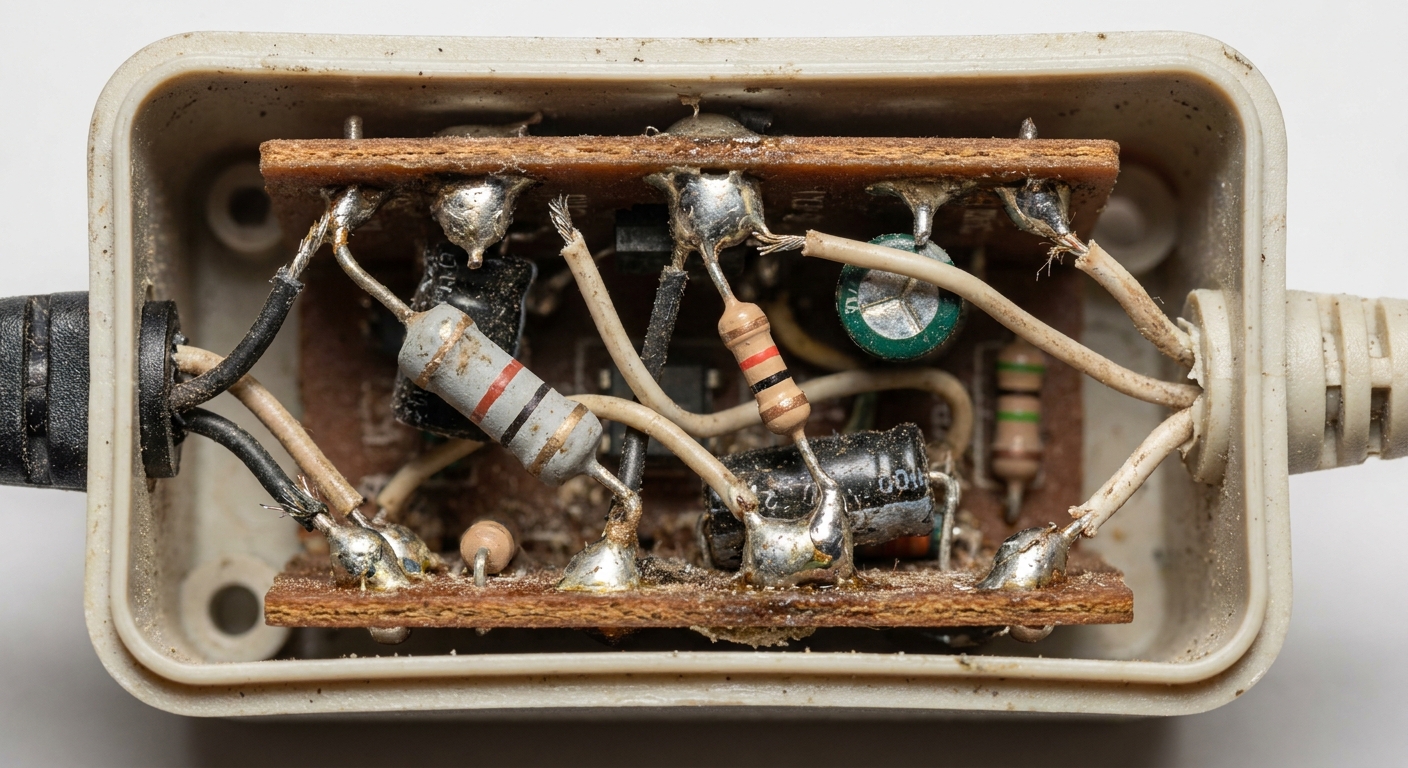
Hidden defects inside cheap circuit boards include cold solder joints, missing safety components, and incredibly thin copper traces that overheat under standard workloads. These internal flaws are completely invisible from the outside, hidden beneath a polished plastic shell. Purchasing a generic non-original power adapter exposes your business to these cut-rate manufacturing practices that ignore basic electrical engineering principles. Over time, vibration or thermal expansion can break these poor solder connections, causing immediate device failure.
Why are cold solder joints so dangerous?
Here is the key: Cold solder joints occur when the solder does not melt completely during assembly, leaving a highly unstable, high-resistance connection. This resistance generates intense localized heat, which can easily melt the circuit board and start a fire.
- High resistance: Restricts current flow, causing the adapter to work intermittently.
- Localized heating: Breaks down nearby components and degrades the PCB substrate.
What essential safety components are missing?
What is the catch? To save pennies on production, cheap manufacturers omit critical protection elements like metal oxide varistors and common mode chokes. These omissions leave your equipment completely vulnerable to everyday electrical anomalies.
- Omitted fuse lines: Mean short circuits will continue to draw power until a fire starts.
- Missing EMI filters: Allow raw electrical noise to bleed back into your electrical grid.
| Manufacturing Aspect | Certified PCB Assembly | Cheap PCB Assembly | |
|---|---|---|---|
| Solder Joint Integrity | 100% AOI (Automated Optical) | Manual soldering, no inspection | |
| Safety Component Count | Full (Fuses, MOVs, Chokes) | Bare minimum (often bridged) | |
| Board Material | FR-4 Flame Retardant Glass Epoxy | Paper-phenolic (highly flammable) |
Under-the-hood defects are the primary driver of premature adapter deaths and unexpected safety incidents in the field.
Key Takeaway: Substandard assembly practices and omitted safety components on cheap PCBs create invisible hazards that lead to catastrophic device failure.
⑦ Why are international safety certifications so essential?
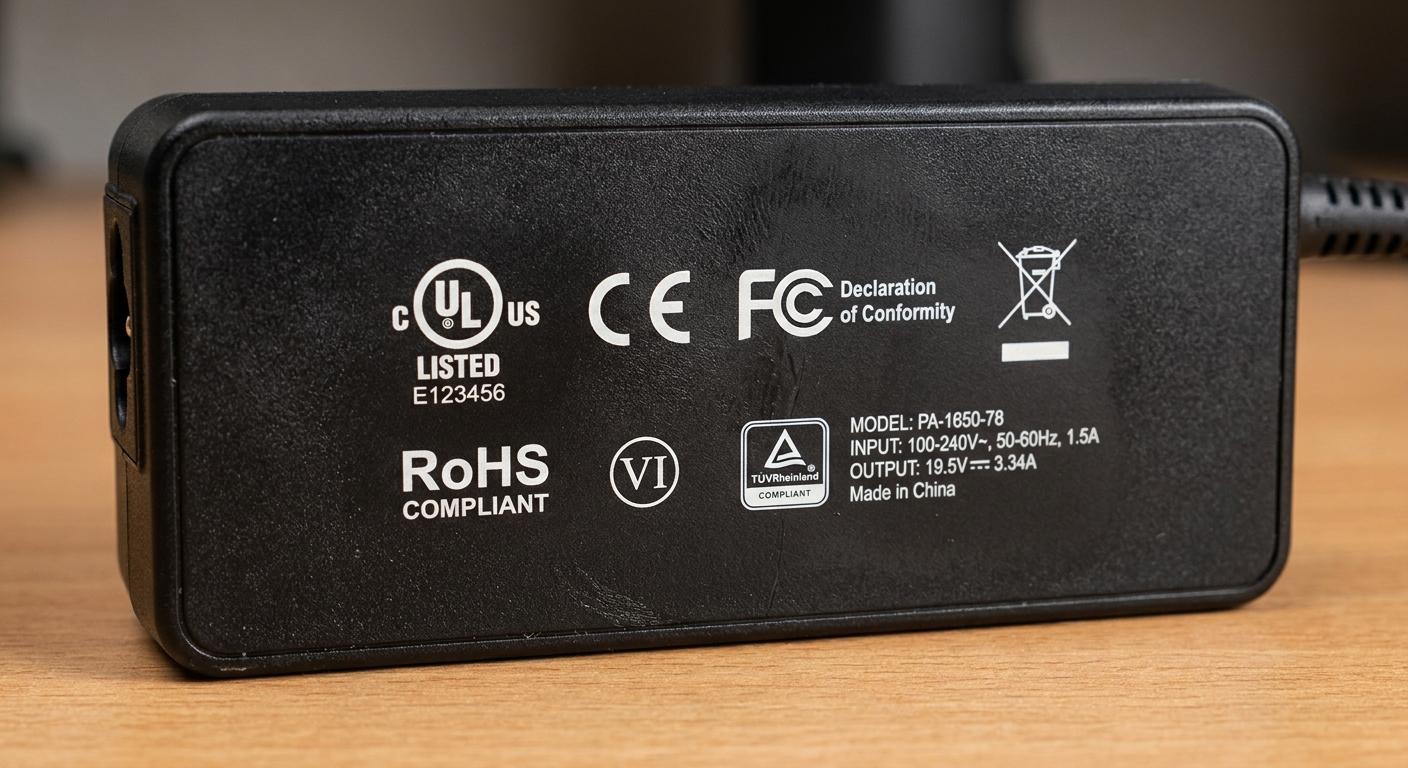
International safety certifications are essential because they guarantee that the power supply has passed rigorous third-party laboratory testing for fire safety, electrical insulation, and energy efficiency. These certification marks are not merely decorative logos; they represent compliance with strict national and global safety laws. Importing a generic non-original power adapter without genuine certifications can lead to massive customs seizures and severe legal liabilities for your organization. Professional manufacturers spend thousands of dollars per product line to secure these vital certifications from recognized bodies.
What do marks like UL, CE, and FCC actually mean?
Think about it: Each stamp on the casing represents a specific battery of electrical and environmental stress tests that the adapter has successfully weathered. Buying products without these marks means deploying completely untested high-voltage hardware in your offices.
- UL (Underwriters Laboratories): Certifies rigorous electrical safety and fire protection.
- CE (Conformité Européenne): Confirms compliance with EU health, safety, and environmental laws.
- FCC (Federal Communications Commission): Ensures electromagnetic emissions are within safe limits.
How do fake certification markings put you at risk?
But that is not all. Many low-quality factories print fake certification logos on their casings to deceive busy procurement managers. Verified suppliers provide official registration numbers that can be looked up and verified in public databases.
- Counterfeit marks: Offer zero guarantee of safety or component testing.
- Legal liability: Your business faces severe fines if uncertified hardware causes property damage.
| Certification Mark | Focus Area | Verification Method | |
|---|---|---|---|
| UL / cUL | Electrical Safety & Fire Prevention | Online directory search via File Number | |
| CE Mark | European Safety & Environmental Standards | Manufacturer Declaration of Conformity | |
| FCC | Electromagnetic Compatibility (EMC) | FCC ID lookup in database |
Validating safety certifications prior to bulk procurement is the ultimate shield against workplace liability and hardware damage.
Key Takeaway: Legitimate safety certifications ensure a power supply has been independently validated to protect people and property from electrical harm.
⑧ How does electromagnetic interference affect your monitors?
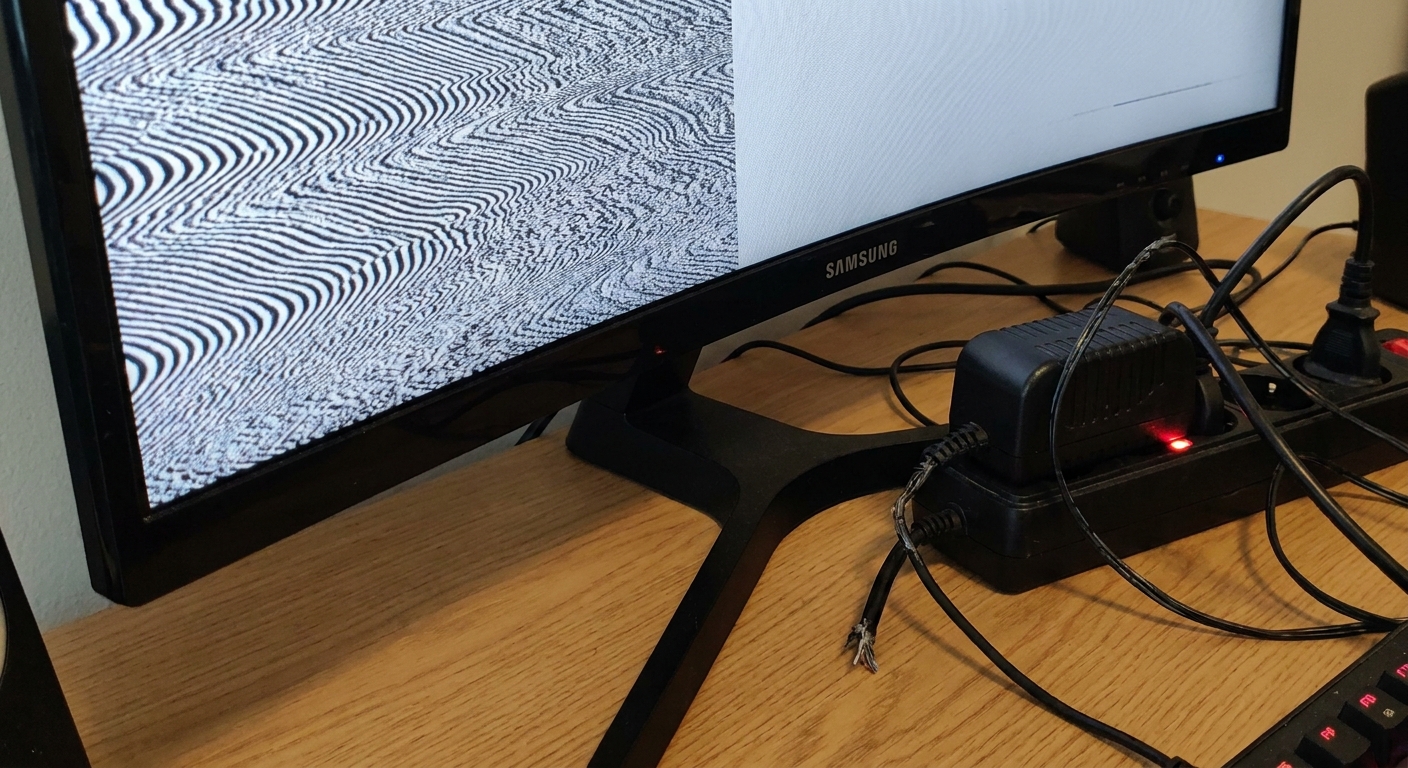
Electromagnetic interference affects your monitors by injecting raw high-frequency noise into the video signal cable, resulting in flickering screens, wavy lines, and severe audio hums. This happens because low-quality power supplies do not include electromagnetic shielding or filtering components. Utilizing a cheap non-original power adapter in close proximity to your workstations will turn it into a miniature radio transmitter that disrupts nearby wireless networks and display signals. This invisible electrical pollution reduces productivity and causes chronic eye strain for your staff members.
Why do cheap adapters emit high levels of EMI?
Here is the key: High-speed switching transistors inside adapters generate strong electromagnetic fields as they convert AC power to DC. Certified adapters wrap these components in metal shields and use filtering chokes to absorb this stray radiation.
- No shielding: Allows electromagnetic fields to radiate freely into the surrounding room.
- Missing chokes: Permits high-frequency noise to travel down the power cable into your device.
How does electromagnetic noise disrupt B2B workspaces?
What is the catch? In a dense office environment, the cumulative electromagnetic noise from dozens of cheap chargers can cripple Wi-Fi performance and corrupt sensitive data transfers. This can cause confusing network dropouts that IT departments struggle to diagnose.
- Flickering displays lead to reduced employee comfort and lower overall work output.
- Unshielded adapters can interfere with local medical or laboratory instrumentation.
| Interference Type | Shielded Power Supply | Unshielded Non-Original | |
|---|---|---|---|
| Radiated Emissions | Complies with FCC Class B | Exceeds legal limits significantly | |
| Display Flicker Risk | Minimal / None | High (on analog and digital lines) | |
| Wi-Fi Signal Degradation | No impact | Can cause localized speed drops |
Investing in shielded, FCC-compliant power supplies ensures a clean, distraction-free electrical environment for your entire team.
Key Takeaway: Poorly shielded adapters broadcast intense electromagnetic noise that disrupts screens, wireless networks, and office electronics.
⑨ How can B2B procurement managers identify quality adapters?

B2B procurement managers can identify quality adapters by verifying safety certification database entries, examining casing materials, and auditing the manufacturer’s quality control systems. A professional procurement process focuses on total cost of ownership and safety rather than looking for the absolute lowest unit price. Accepting a low-bid quote for a non-original power adapter often leads to massive failure rates, expensive returns, and damaged brand reputation. Taking time to inspect samples and verify documentation saves thousands of dollars in long-term hardware replacement costs.
What are the steps to verify a power supply supplier?
Think about it: A reliable manufacturing partner will openly share their UL file numbers, ISO certificates, and factory audit reports without hesitation. If a supplier is evasive about sharing their engineering documentation, you should walk away immediately.
- Verify UL/CE numbers: Input the supplier’s file numbers directly into the certification databases.
- Request sample testing: Put actual production samples through electrical and thermal load testing.
What physical signs indicate a high-quality adapter?
But that is not all. The physical construction of the adapter speaks volumes about its internal engineering standards. High-quality power supplies have a solid weight, flawless ultrasonic welding joints, and thick, professionally strain-relieved cords.
- Ultrasonic welding: Creates a seamless, tamper-proof casing that cannot be pried open.
- Sturdy weight: Indicates the presence of robust heatsinks and thick copper coils.
| Evaluation Step | Professional Supplier Audit | Low-End Generic Supplier | |
|---|---|---|---|
| UL File Verification | Searchable database entry matches brand | Non-existent or registered to third party | |
| Material Quality | UL 94 V-0 plastic with heavy-duty cord | Light, cheap plastic with flimsy wiring | |
| Factory Certifications | ISO 9001, ISO 13485 (Medical) | No formal quality management systems |
Implementing a rigorous verification checklist protects your company from the operational hazards of counterfeit charging hardware.
Key Takeaway: Diligent procurement managers identify premium adapters by cross-referencing safety databases and inspecting physical build standards.
⑩ What role does automated manufacturing play in product safety?
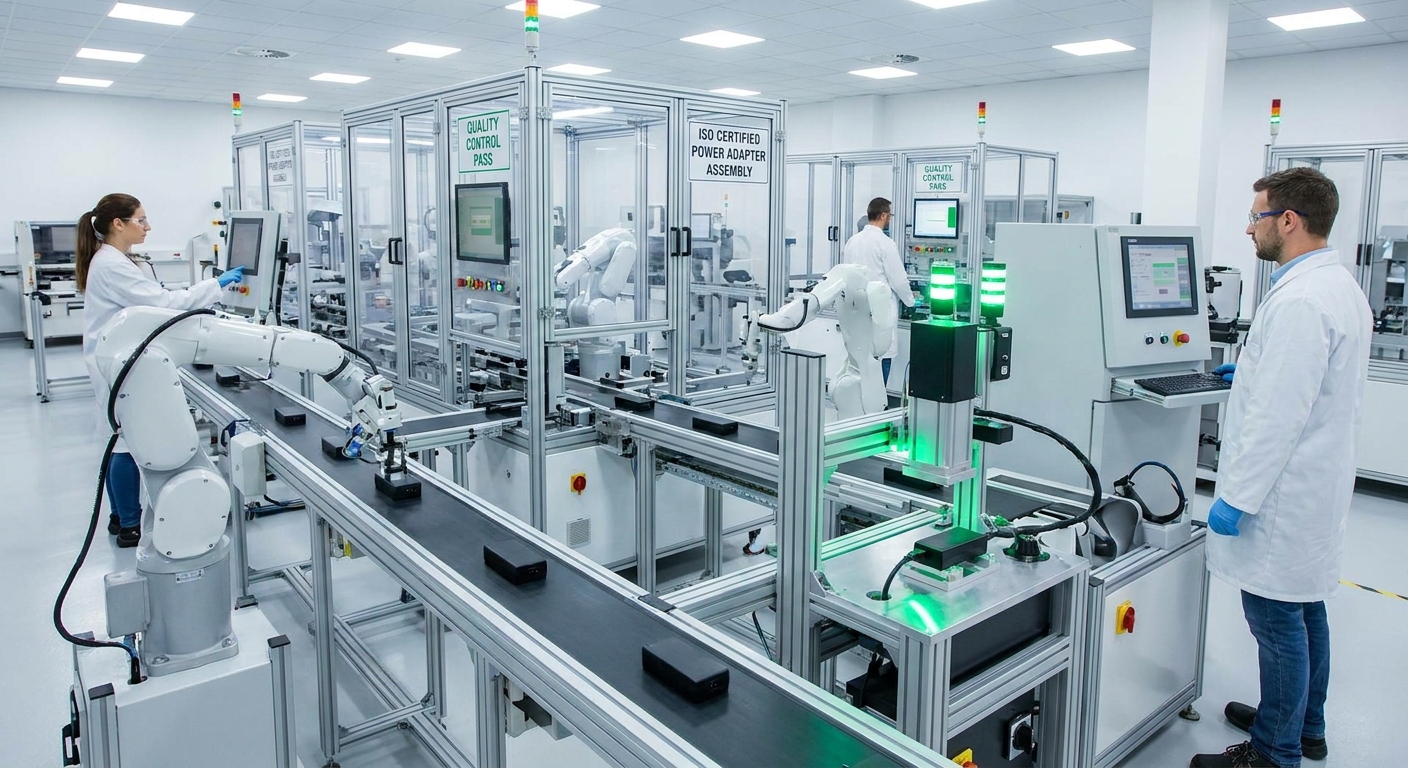
Automated manufacturing plays a decisive role in product safety by eliminating human error, ensuring ultra-precise solder joints, and enforcing uniform quality testing on every single unit. Unlike manual assembly lines where fatigue can lead to missed components or loose wires, robotics deliver flawless consistency across million-unit production runs. Sourcing a cheap non-original power adapter usually means buying from a facility that relies on outdated manual soldering and inconsistent hand assembly. Choosing adapters built on fully automated lines guarantees that the product you receive matches the certified prototype perfectly.
Why does robotic precision prevent electrical failures?
Here is the key: Automated surface mount technology (SMT) places tiny micro-components onto PCBs with sub-millimeter precision. This level of accuracy is impossible to replicate by hand, especially during long, exhausting shifts.
- SMT placement: Guarantees perfect component alignment and minimizes short-circuit risks.
- Automated Optical Inspection: Instantly scans and rejects any circuit board with solder defects.
How does comprehensive automated testing protect your deployment?
What is the catch? Low-end manufacturers only test a tiny fraction of their production run, allowing thousands of defective units to ship to customers. Top-tier factories put every single adapter through automated aging and high-voltage isolation tests before packaging.
- ATE (Automatic Test Equipment): Validates voltage, current, and ripple parameters for every unit.
- Burn-in testing: Runs the adapter under full load for hours to catch early component failures.
| Manufacturing Standard | Automated High-Tech Factory | Manual Low-Cost Workshop | |
|---|---|---|---|
| Assembly Method | Robotic SMT & Automated Assembly | Hand soldering & manual wiring | |
| Testing Coverage | 100% of units (ATE & Burn-In) | Statistical sampling (often < 1%) | |
| Defect Rate (PPM) | < 100 Parts Per Million | > 10,000 Parts Per Million |
Demanding automated manufacturing standards ensures that your B2B hardware is powered by safe, uniform, and reliable electronics.
Key Takeaway: Fully automated assembly and comprehensive testing eliminate human error to deliver power adapters of consistent quality and safety.
The Strategic Path to Safe Power Solutions
Selecting the correct power supply is not just a technical detail; it is a critical safeguard for your business operations, equipment longevity, and workplace safety. This article has detailed the severe risks of cheap chargers, including electrical fires, battery degradation, voltage instability, and electromagnetic interference. At Merryking Power, we eliminate these hazards by engineering high-quality, certified, and fully customized power adapters tailored to your precise industrial, medical, and consumer electronics applications. Let us help you protect your technology investments and eliminate the hidden dangers of uncertified power supplies. We invite you to contact us today to discuss your custom manufacturing requirements, receive certified product samples, and secure your supply chain with premium, worry-free power solutions built for absolute reliability.
Frequently Asked Questions
Can I use a different brand adapter if the voltage and connector match?
Yes, but only if the adapter carries equivalent safety certifications and matches the device’s exact polarity and current requirements. A matching connector does not guarantee that the internal electronics are high-quality or safe for continuous use. You must verify that the new power supply is built to the same strict standards as the original before plugging it in.
How do I know if my power adapter is genuinely certified?
You must verify the certification file numbers directly in the official online databases of testing labs like UL or TÜV. Many counterfeit adapters print fake safety logos on their plastic enclosures to trick buyers. A legitimate manufacturer will provide searchable registration records that confirm their compliance status.
What is the best way to prevent power adapter fires in an office?
The absolute best way is to exclusively source and deploy adapters certified by recognized testing laboratories. Additionally, staff should be trained to avoid overloading extension leads and to immediately report any charger that feels unusually hot. Implementing regular safety audits of workplace electrical equipment is another highly effective preventative measure.
Can a non-original adapter permanently destroy my laptop?
Yes, an unregulated voltage spike from a cheap charger can instantly burn out the sensitive microprocessors on your motherboard. Low-quality adapters lack overvoltage protection, meaning they cannot block sudden surges from passing directly into your computer. This often leads to catastrophic hardware failure that requires a complete device replacement.
How do I know if a power adapter is too cheap to be safe?
If the unit price is significantly lower than market averages and lacks verifiable certification numbers, it is unsafe. High-quality copper, flame-retardant plastics, and rigorous safety testing have fixed manufacturing costs that cannot be bypassed. A remarkably low price tag always indicates that critical safety components have been omitted during production.